THE SHORT ANSWER
The key idea, first.
An air vortex cannon pushes a short pulse of air through an opening. Differences in air velocity near the opening produce a shear layer that rolls into a vortex ring. The ring travels through surrounding air while its flow circulates and exchanges fluid with its surroundings. A light target can reveal an arriving airflow, but target movement alone does not show the ring's complete structure.
- Explain how a brief air pulse can form a vortex ring.
- Distinguish a target response from a direct view of the airflow.
- Design a comparison that changes one operating condition at a time.
WATCH & NOTICE
Look closely at the demonstration.
Use the six-second silent workshop reference as a record of operation, then use the explanation below to interpret the airflow.
Identify the input
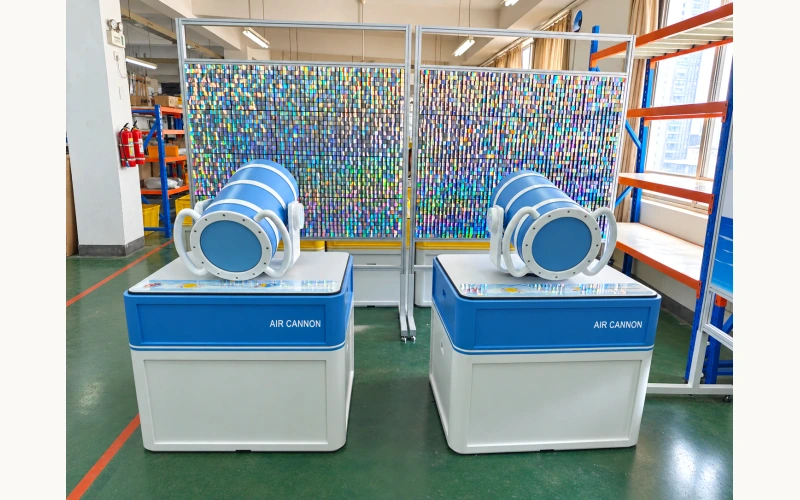
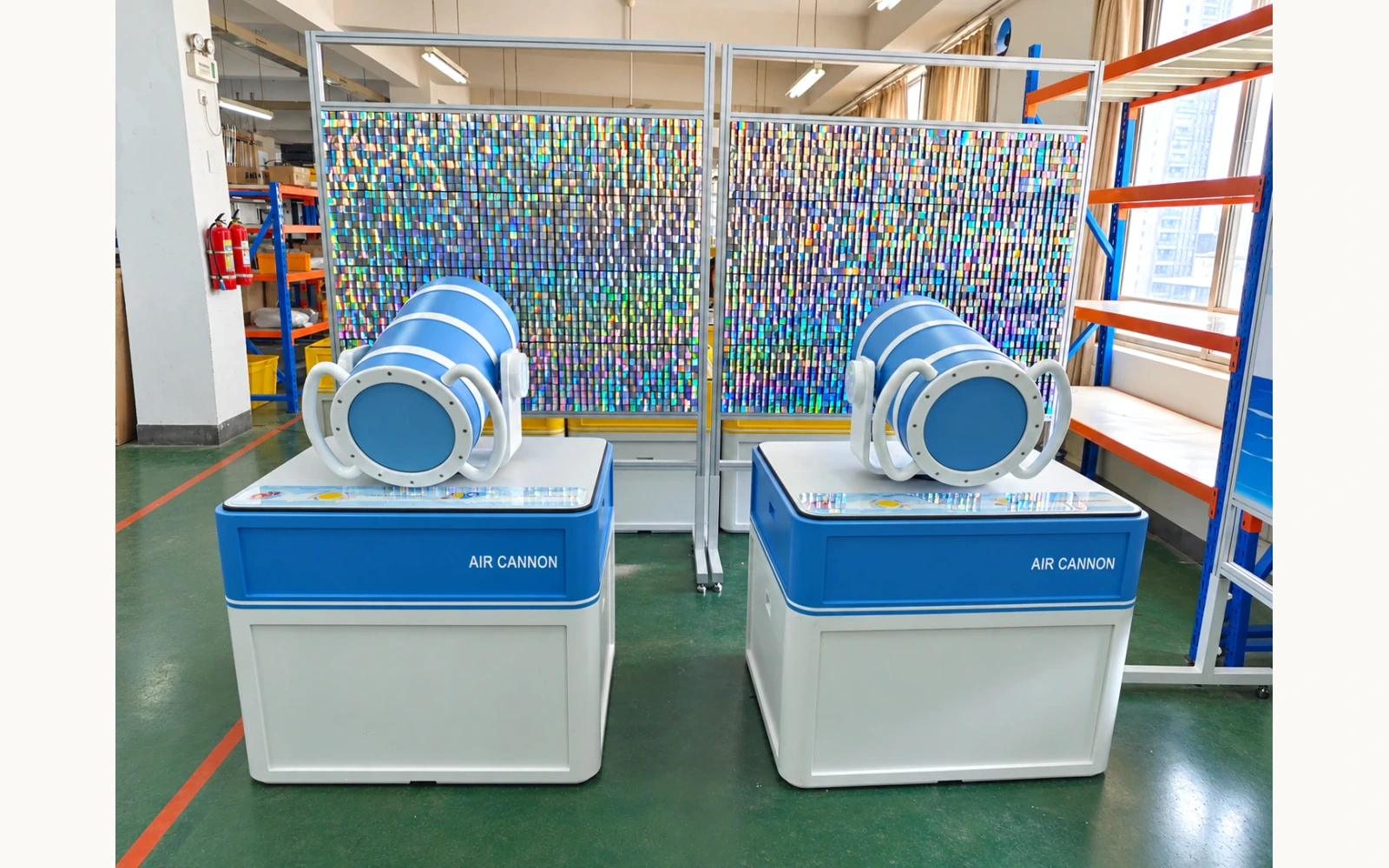
The operators hold the barrel handles and tap the circular rear membranes.
Locate the targets
Two hanging-tile panels are positioned behind the operating stations; compare their location with each barrel's direction.
Follow one station
Replay one operator's action without switching between the two stations. Separate what is visible from what you infer about the air.
About this video reference
The short clip is an operating reference, not a flow visualization or calibrated range test. It does not resolve the vortex core, quantify target force or establish performance at a stated distance.
01 / EXPLAINING THE IDEA
Begin with a pulse rather than a steady breeze
A membrane-operated air cannon briefly reduces the space available inside its chamber and pushes air toward an outlet. The University of Wisconsin–Madison describes this action in its vortex cannon demonstration. The important feature for the explanation is a short pulse: the airflow starts, forms a moving structure and then separates from the source.
Ask learners to trace three arrows: hand movement, displaced air, downstream response. The flexible membrane does not launch a solid object.[1]
02 / EXPLAINING THE IDEA
Why the flow rolls into a ring
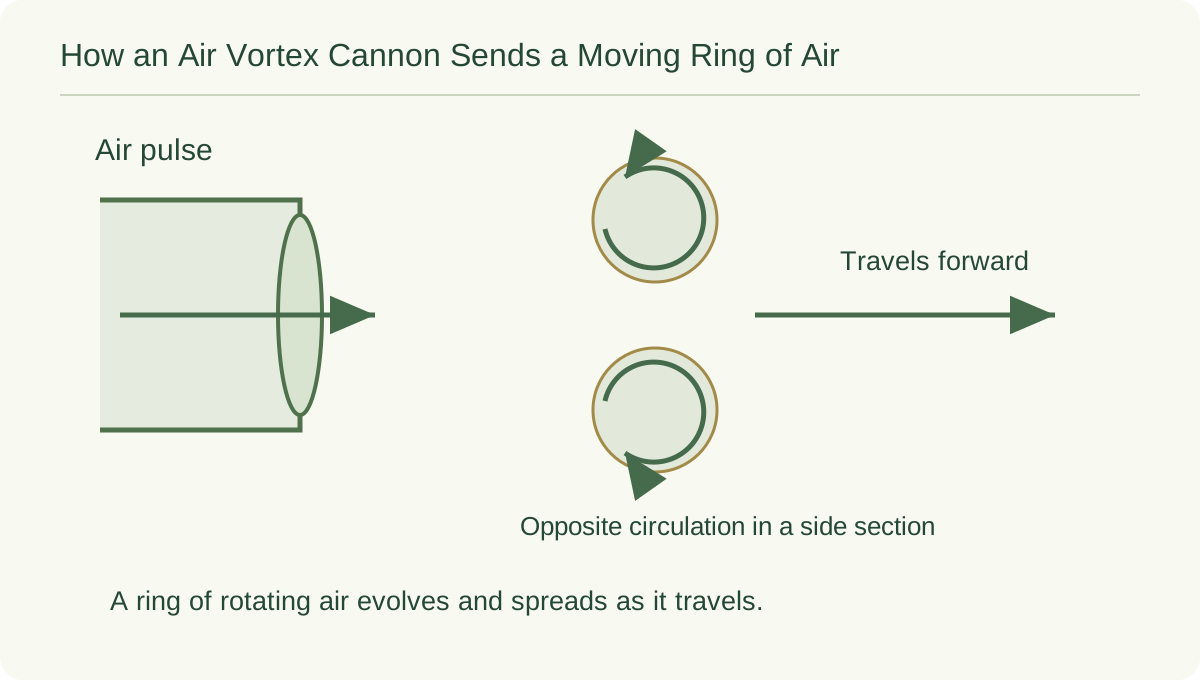
Air leaving the opening moves next to air that is moving more slowly. This difference in velocity creates a shear layer. In the separated flow around an outlet edge, the layer can roll up into a concentrated vortex. With a circular opening, that rolling structure can extend around the circumference to form a ring.
Maxworthy's research on turbulent vortex rings describes this edge-generated roll-up. Its laboratory generator is not the museum exhibit, so detailed measurements should not be transferred to the local cannon. The paper explains a mechanism, rather than specifying this installation's performance.[2]
03 / EXPLAINING THE IDEA
The ring is a pattern of moving fluid
Imagine a ring-shaped region of circulation, with the whole structure moving forward while air also circulates around its core. This is a conceptual picture, not an empty shell. It helps explain why the ring can remain recognizable beyond the opening, even though there is no rigid surface holding it together.
The fluid associated with a vortex ring is not permanently sealed inside it. Dabiri and Gharib's experiments describe entrainment: surrounding fluid becomes incorporated into the moving flow. Their work also distinguishes different stages of this process. Use that finding to replace the idea of a fixed parcel of air travelling unchanged from cannon to target.[3]
04 / EXPLAINING THE IDEA
What a moving target can tell you
The Wisconsin demonstration uses airflow to move light objects. A hanging target therefore provides an accessible indicator that air has reached it and transferred momentum. It does not reveal every part of the incoming flow. A moving tile could show an airflow response without telling you the ring's diameter, circulation or speed.
Real vortex rings exchange fluid with their surroundings and develop a wake, as Maxworthy's study describes. Their structure and speed evolve. A stronger response at one target is not evidence that the airflow will maintain the same effect indefinitely. Distance, alignment and surrounding air movement belong in the observation record.[1][2]
05 / EXPLAINING THE IDEA
Read the workshop clip carefully
The local silent video records two membrane-operated stations in front of hanging-tile panels. The original guide identifies the operators holding the handles and tapping the rear membranes. First locate those actions; then note the positions of the panels. The clip is short, so replaying a single station can be more useful than trying to follow both at once.
Write two columns on a worksheet: observed and inferred. Put the hand action and visible apparatus in the first. Put the proposed travelling vortex in the second unless a separate flow visualization makes it directly visible. This distinction strengthens an explanation without overstating the footage.
06 / EXPLAINING THE IDEA
Turn the demonstration into a fair comparison
Choose one question that the available setup can answer. For example, does a small change in aim alter which part of a target responds? Keep the target, station and approximate membrane action as consistent as practical. Make several attempts and record differences rather than selecting only the most dramatic one.
If comparing distance is permitted in the operating instructions, use marked positions and leave other conditions unchanged. Describe membrane action; do not call taps equal in force without measuring them. Identify a response scale as observation rather than force measurement.
| Question | Change | Keep consistent |
|---|---|---|
| Where does the airflow arrive? | Barrel direction | Target and station |
| How repeatable is the response? | Repeat the same action | Position and observation method |
| Does response vary with separation? | Approved target position | Aim, target and recorded tap description |
07 / EXPLAINING THE IDEA
Make the invisible explanation readable
Place a clearly labelled conceptual diagram beside the operating reference: an outlet, a rolled shear layer and a travelling ring. Use arrows for both circulation and forward motion. A caption should state that the diagram explains a general flow process; it is not an image extracted from the workshop video.
Finish with a claim-and-evidence prompt: what suggests that moving air reached the target, and what would reveal the flow itself? Learners can propose an additional visualization. A museum brief should specify the visitor action, target response and supplied operating limits.
Common questions.
Is the vortex ring a hollow ball of compressed air?
No. It is a circulating fluid structure with no solid skin. It can incorporate surrounding air and leave fluid in its wake as it travels.
Does an air cannon keep the same strength at every distance?
No. A real vortex ring evolves and interacts with surrounding air. A useful distance depends on the generator, target, alignment and room conditions; the accompanying video does not measure it.
Does the workshop video show the vortex ring directly?
The guide describes operator actions and target panels. The ring explanation comes from fluid mechanics sources; this silent operating reference is not a resolved flow visualization.
SCIENCE & FURTHER READING
Follow the sources.
Read the original scientific explanations and teaching resources behind this article.
- University of Wisconsin–Madison Physics — Vortex Cannon
Primary university demonstration: a flexible diaphragm displaces air through an opening and airflow can move light targets. This article uses only the ordinary air demonstration.
- T. Maxworthy — Turbulent vortex rings, Journal of Fluid Mechanics (1974)
Research on edge-generated vortex roll-up, entrainment and wake formation. Laboratory numerical results are not exhibit specifications.
- J. O. Dabiri and M. Gharib — Fluid entrainment by isolated vortex rings (2004)
Experimental evidence that vortex rings entrain surrounding fluid; no laboratory entrainment percentage is assigned to the museum cannon.
Editorial: Exhibit Engineers science & exhibit team. Scientific references are cited for the explanations; product configuration details follow the linked exhibit records.