
THE SHORT ANSWER
The key idea, first.
Bernoulli's principle relates pressure, speed and height along a streamline in an idealized steady flow. At the same height, faster flow has lower static pressure when the relevant total energy is conserved. It is not a rule that any moving air has lower pressure than all nearby air. Airflow exhibits may also involve stagnation pressure, drag, curved flow, mixing and mechanical supports.
- State the main conditions behind the incompressible Bernoulli equation.
- Distinguish static pressure, stagnation effects, drag and entrainment.
- Separate visible exhibit behavior from pressure or force measurements that a video does not provide.
WATCH & NOTICE
Look closely at the demonstration.
The Bernoulli airflow exhibit workshop recording shows an operator using the front controls, green suspended shapes and three transparent air outlets.
Locate the control
Watch the operator's hand on the cabinet control during the demonstration.
Compare the geometry
Look at the different green profiles and their positions relative to the clear outlets.
Notice the supports
Include the visible overhead suspension and guard when describing the arrangement.
About this video reference
The film does not measure airspeed, pressure or force and does not show freely levitating balls. The suspended pieces' behavior alone cannot isolate a Bernoulli pressure effect from other forces.
01 / EXPLAINING THE IDEA
Describe the arrangement before explaining it
An object responding to moving air makes an inviting puzzle: where does the force come from? First identify the air outlet, the object's shape and every visible support. In the accompanying workshop footage, the green pieces are suspended from above. Their position should not be described as free levitation, and the presence of a blower is not a pressure measurement.
For a group discussion, invite two descriptions of the same scene. One should contain only observations; the other should propose a mechanism. This helps distinguish a useful hypothesis, such as an uneven pressure distribution, from something the recording directly establishes. A scientific name becomes more valuable when learners can say what evidence would support it.
02 / EXPLAINING THE IDEA
Bernoulli connects energy along a streamline
A streamline follows the local direction of flow. In the usual incompressible Bernoulli model, pressure, motion and elevation contribute to an energy balance along that line. If elevation is unchanged and no energy is added or lost, an increase in speed accompanies a decrease in static pressure. Pressure differences can accelerate the fluid; the equation describes the relationship.[1][2]
This version assumes steady flow, approximately constant density and negligible viscous losses along the comparison path. A fan adds energy, while substantial mixing and friction dissipate it, so the same constant cannot simply be carried through either process. Different streamlines need not share the same constant. Choosing the comparison points is part of using the equation correctly.[1]
03 / EXPLAINING THE IDEA
Slow flow can produce a high-pressure region
Static pressure is the local pressure within the fluid; dynamic pressure, one half density times speed squared, is an energy-related quantity. It is not an extra uniform pressure acting in every direction. When a flow is slowed toward rest at a stagnation point, its static pressure rises under the appropriate Bernoulli assumptions.[1][2]
That matters for an upward jet meeting a ball. Air slowing against the underside can produce higher pressure there, helping provide upward force against weight. The Exploratorium's Balancing Ball activity explicitly discusses this region. Saying that the ball rises only because fast air has low pressure misses an important part of the force distribution.[3]
04 / EXPLAINING THE IDEA
Separate support from sideways stability
Holding an object up and returning it toward a jet's center are different questions. In an appropriate ball-and-jet arrangement, air can curve around the ball and leave with a changed direction. The ball exerts a force on the air; the air exerts a reaction on the ball. Pressure gradients help turn the flow, connecting the pressure and momentum descriptions.[3]
Drag is the component of aerodynamic force along the relative flow; lift is perpendicular to it. For a ball in a vertical stream, upward support is largely a drag question. A sideways restoring response depends on the actual flow and geometry. A supported shape beside an outlet may have additional constraints, so a familiar ball explanation should not be assigned automatically.[1]
05 / EXPLAINING THE IDEA
Entrainment brings surrounding air into the stream
A jet can draw surrounding fluid into its moving flow. This entrainment involves interaction and mixing across the jet boundary; turbulent jets broaden as ambient fluid joins them. It is a flow process, distinct from the drag force on a solid object and from an ideal energy calculation along one streamline.[4]
Avoid comparing a jet's speed with the room's still air and immediately declaring the entire jet to be at lower pressure. The two regions may have different energy histories, and a free jet can be close to ambient static pressure. Entrainment, pressure gradients and momentum transfer may all matter, but one slogan cannot determine their relative contributions in an unmeasured exhibit.[1][2]
06 / EXPLAINING THE IDEA
Use examples that identify the comparison points
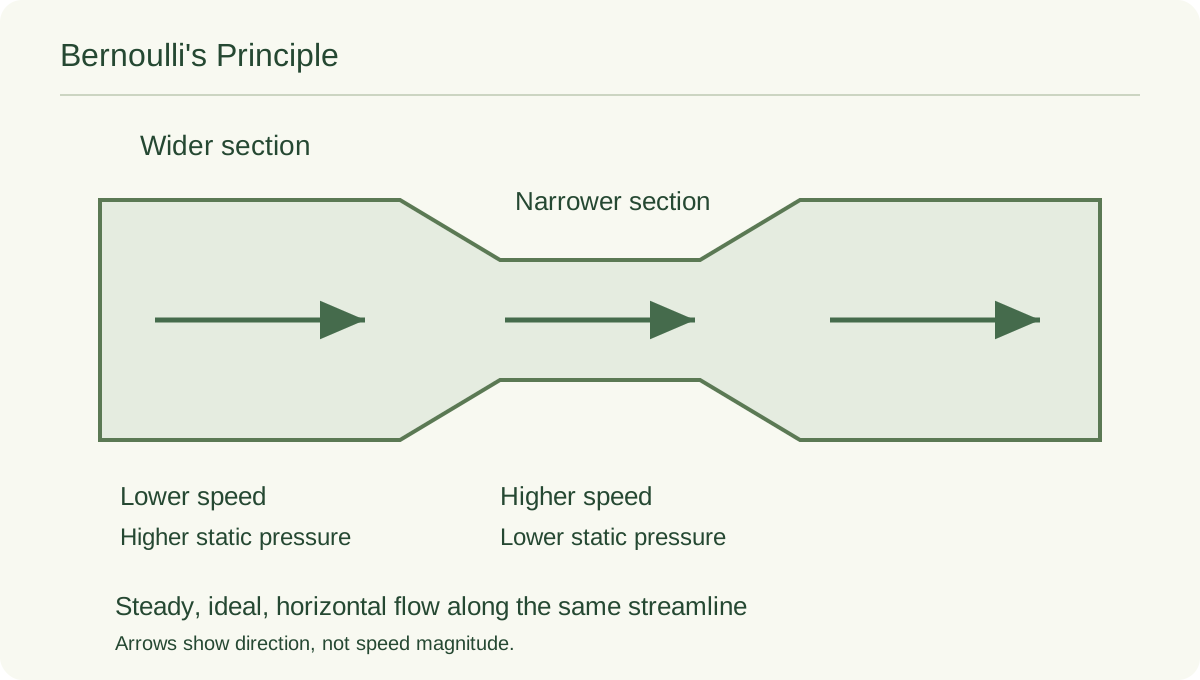
Consider a smooth horizontal passage that narrows. For steady incompressible flow without leakage, continuity requires a higher average speed in the narrower section. If losses are small, Bernoulli then predicts a lower static pressure there. This example works because the connected flow, heights and assumptions are identified, not because narrow spaces always create low pressure.[2]
A second example is a pressure probe that brings a small part of the flow to rest and compares it with local static pressure. Under suitable conditions, their difference relates to speed. Both examples make a stronger lesson than guessing pressure from an object's appearance: they specify which quantities could be measured and which equation connects them.[1][2]
07 / EXPLAINING THE IDEA
Build the discussion around a testable question
For the Bernoulli airflow exhibit, ask observers to compare profiles, outlets and suspension before predicting a response. Then ask what additional information would distinguish their proposed explanations: airflow direction, pressure at defined locations, the support forces or the object's movement. The aim is a defensible explanation of this arrangement, not the repetition of a familiar label.
In a separate supervised classroom investigation, change one allowed variable at a time and record the response before offering an explanation. A slower or faster setting can prompt a new hypothesis, but without measurements it remains qualitative. Returning to the original observation helps learners see where Bernoulli's principle is useful and where a broader force analysis is needed. A useful closing response identifies the object being analyzed, the direction of the proposed force and the measurement that would test the explanation under those conditions.
Common questions.
Does faster air always mean lower pressure?
No. That comparison requires the relevant Bernoulli conditions and a justified energy constant. It cannot be applied indiscriminately between unrelated flows or across a fan.[1]
Is a ball held up only by low pressure?
No. An upward jet can create higher pressure where it slows beneath the ball. The complete pressure distribution and momentum transfer determine the aerodynamic force.[3]
Are entrainment and drag the same thing?
No. Entrainment brings surrounding fluid into a flow; drag is a component of force on an object. Both can occur in one demonstration.[4]
SCIENCE & FURTHER READING
Follow the sources.
Read the original scientific explanations and teaching resources behind this article.
- NASA Glenn: Bernoulli's Equation
Energy balance, incompressible assumptions, streamline comparisons and pressure-based aerodynamic forces.
- OpenStax University Physics: Bernoulli's Equation
Pressure-speed examples, nozzle boundary pressure and pressure-based speed measurement. Its simplified entrainment wording is supplemented by the Cambridge source.
- Exploratorium Science Snack: Balancing Ball
Separate discussion of high pressure beneath a supported ball and the pressure/momentum explanations of lateral restoring force.
- University of Cambridge IEEF: Entrainment across turbulent interfaces
Primary institutional account of ambient-fluid entrainment, turbulent mixing and flow broadening; not evidence of measured flow inside this exhibit.
Editorial: Exhibit Engineers science & exhibit team. Scientific references are cited for the explanations; product configuration details follow the linked exhibit records.