
THE SHORT ANSWER
The key idea, first.
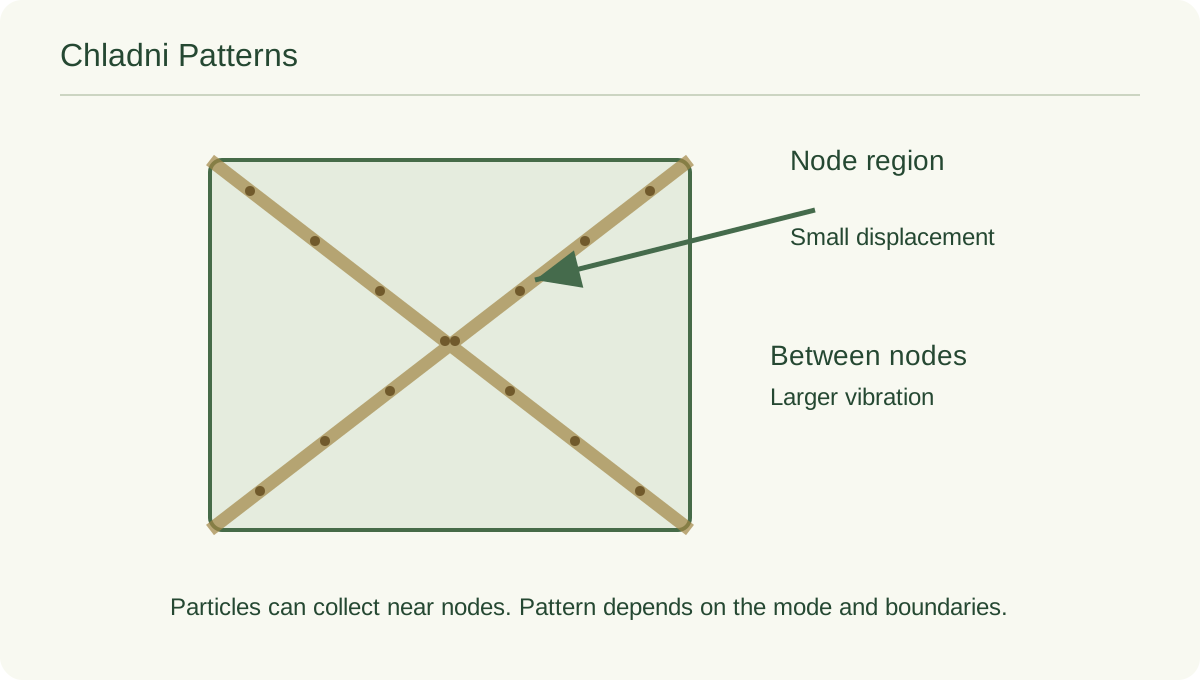
Chladni patterns are arrangements of granules that reveal the relatively still nodal lines of a vibrating plate. Strongly moving regions displace particles, which can accumulate near nodes when a suitable mode is excited. A pattern depends on plate geometry, material, support and driving conditions. Not every selected frequency produces a clear, stable figure, and a sand line is not the path of a traveling sound wave.
- Identify nodal lines as regions of small vibration amplitude.
- Distinguish a plate's vibration modes from the method used to drive it.
- Explain why frequency changes do not guarantee a stable pattern at every setting.
WATCH & NOTICE
Look closely at the demonstration.
The Chladni Patterns Exhibit recording shows a physical plate, bright granules, a protective cover and the control area. Use it to distinguish the visible particle distribution from the motion being inferred.
Find the plate
Identify the square vibrating surface and the granules distributed on and around it.
Watch the adjustment
Notice the control operation and changing display without treating the displayed values as calibrated measurements.
Compare distributions
Follow the particle arrangement across the recording; distinguish clear concentrations from diffuse material.
About this video reference
The recording does not establish the exact vibration mode, calibrated frequency or amplitude at each setting. It does not demonstrate that every setting produces a stable nodal pattern.
01 / EXPLAINING THE IDEA
Begin with the granules, not a finished diagram
A Chladni plate makes vibration visible indirectly. Instead of watching the metal bend through each rapid cycle, you watch small particles move across its surface. Ask which areas become more heavily covered and which become clearer. A useful first sketch marks particle concentrations without immediately assuming that every visible patch is a complete vibration mode.[1]
The accompanying exhibit film is a starting point for that observation. Compare the plate with the control area, then return attention to the particles. A changing numerical display and a changing distribution are two observations to connect carefully. Neither tells you, by itself, the plate's full motion or the forces acting on every granule.
02 / EXPLAINING THE IDEA
Nodes move little while other regions vibrate strongly
In a suitable vibration mode, some regions of the plate move strongly while other regions have very small displacement. The latter form nodal lines. Antinodal regions have larger vibration amplitudes. The plate is not simply rising and falling as one rigid sheet: different parts participate differently in the bending pattern.[1]
Particles in strongly moving areas can be bounced and displaced. Over time, they can collect along the quieter nodal regions, making a spatial pattern visible. The lines therefore tend to mark places where the plate moves least, not where it vibrates most. In a real apparatus, grains, friction and finite motion can leave broadened or imperfect lines.[1][4]
03 / EXPLAINING THE IDEA
A mode is a shape of motion
A vibration mode describes a characteristic spatial pattern of motion and its associated natural frequency. For a plate, the pattern extends across a surface, so its nodal set can form curves and intersecting lines. A stationary-looking figure does not mean the material has stopped: the moving regions continue to oscillate around their resting positions.[1][2]
For one idealized mode, displacement can be written as a spatial shape multiplied by a time-dependent oscillation. Locations where the shape is zero are nodes throughout the cycle. This is a useful way to think about a standing pattern, but the grains show only part of that information. A particle outline does not reveal the complete amplitude or direction of motion everywhere.[3][1]
04 / EXPLAINING THE IDEA
The driver excites the plate; resonance selects a strong response
A bow or an electromechanical driver can supply repeated forces to a plate. These are ways to excite vibration, not the definition of Chladni patterns. Harvard describes bowed plates, while Oberlin describes a generator and mechanical driver. Their different arrangements illustrate why an explanation should separate the plate's possible modes from the means used to excite them.[1][2]
A periodic force often produces a stronger response near an accessible natural frequency. Damping, forcing location and coupling affect how strongly a mode responds. Between resonances, or with an unsuitable forcing arrangement, the motion may not redistribute grains into a clear figure. Raising a frequency setting therefore does not guarantee a stable pattern at every step.[3][2]
05 / EXPLAINING THE IDEA
Geometry and support help determine the result
A plate's outline, thickness, material and support affect its vibration behavior. A centrally supported circle and a differently supported square should not be expected to share identical patterns at one frequency. A constraint can require a particular region to remain still and alter which shapes are possible. The boundary conditions are part of the experiment.[1][2][4]
This gives educators a useful comparison question: would the same control setting produce the same figure on another plate? Ask what would have to be held constant before comparing results. Frequency is one variable among several. Even attractive symmetry should be treated as an observation to explain, rather than a universal promise for every plate and support arrangement.
06 / EXPLAINING THE IDEA
Record a pattern without claiming more than it shows
Where the exhibit instructions permit adjustment, begin with a small amount of the supplied granules and keep other conditions as consistent as possible. At an allowed setting, give the distribution time to develop before sketching it. Record whether you see distinct lines, scattered grains or a changing mixture. A weak result is useful evidence, not a failed observation.[2]
Then compare another setting and return to the first if the operating procedure allows it. Does a similar figure reappear? Separate repeatability from resemblance: a rough visual match does not prove identical motion. Keep the plate, support and loading unchanged during the comparison, and describe the displayed setting as a setting unless its physical accuracy has been established. Two observers can compare sketches before agreeing on a description. Recording disagreement is helpful when a line is indistinct, a distribution keeps changing or the viewing angle hides part of the plate.[3]
07 / EXPLAINING THE IDEA
Connect the pattern to a larger question about vibration
The Smithsonian describes how particle figures have been used to investigate vibrating plates, including wooden plates involved in violin making. This connection makes the exhibit more than an exercise in recognizing shapes: an object's construction influences how it vibrates. It does not mean that a particular sand figure is a universal measure of musical quality.[4]
For a final discussion, ask learners to explain one dark area and one particle-rich line using the same model. Then ask what the drawing leaves out: oscillation amplitude, phase, multiple simultaneous modes or the effect of the driver. A useful explanation identifies both what the particles reveal and what another observation or measurement would still need to establish.
Common questions.
Does the sand collect where vibration is strongest?
Usually the opposite: suitable granules are displaced from strongly moving regions and accumulate near the relatively still nodal lines.[1]
Will every frequency create a different clear pattern?
No. Clear figures require suitable excitation and particle redistribution. Resonance, damping, support and driving conditions all affect the result.[2][3]
Are the lines the paths taken by sound waves?
No. They indicate relatively still regions in the plate's vibration pattern. They do not trace sound traveling through the surrounding air.[1]
SCIENCE & FURTHER READING
Follow the sources.
Read the original scientific explanations and teaching resources behind this article.
- Harvard Natural Sciences Lecture Demonstrations: Chladni Plates
Plate modes, nodes and antinodes, granular redistribution and bowed excitation. Its plate sizes and materials do not describe the supplied exhibit.
- Oberlin College Physics: Chladni Plates
Electronic driving near resonance, distinct mode figures and differing plate-support arrangements.
- OpenStax University Physics: Forced Oscillations
Natural frequency, periodic forcing, resonance, transients and damping. Used qualitatively; no claim of an exact resonance peak at the undamped frequency.
- Smithsonian National Museum of American History: Chladni Plates
Direct historical apparatus interpretation, dimensions and plate behavior, and use of particle figures to investigate musical-instrument plates.
Editorial: Exhibit Engineers science & exhibit team. Scientific references are cited for the explanations; product configuration details follow the linked exhibit records.