THE SHORT ANSWER
The key idea, first.
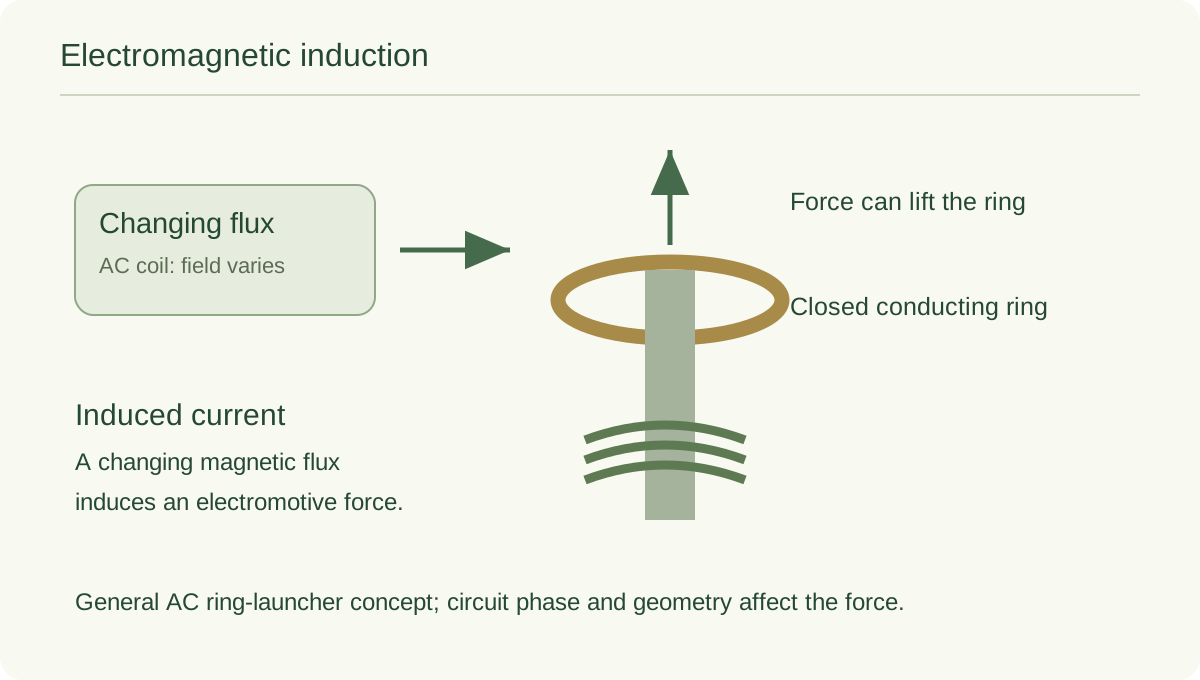
Electromagnetic induction produces an electromotive force when magnetic flux through a loop changes. In a typical AC ring launcher, this drives current around a closed conducting ring. The current interacts with the coil's magnetic field, producing a force that can lift the ring. Electrical conductivity matters; the ring need not be ferromagnetic. Its motion depends on the circuit, field geometry and operating conditions.
- Explain the difference between a magnetic field and changing magnetic flux.
- Connect a closed conducting path to induced current and magnetic force.
- Separate design observations from evidence of physical operation.
WATCH & NOTICE
Look closely at the demonstration.
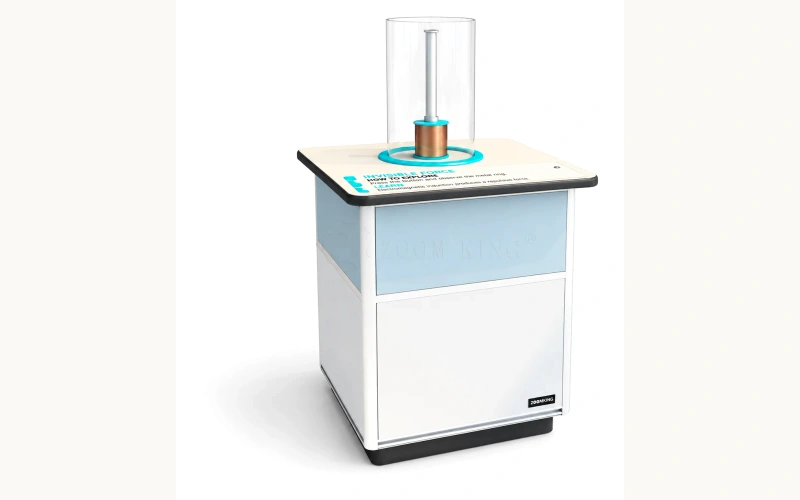
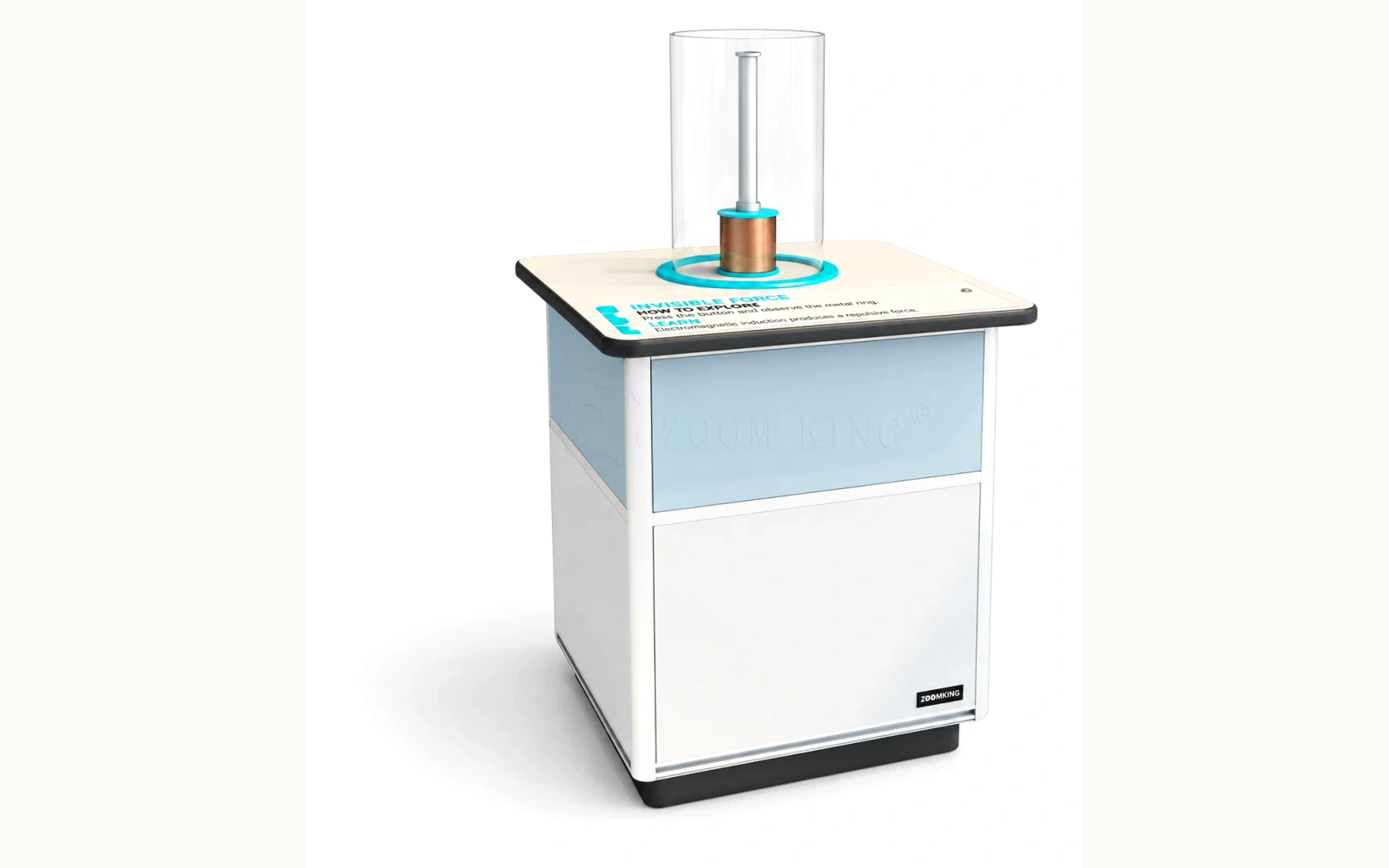
The available Jumping Ring media is a twelve-second sequence of existing still design views. Inspect the proposed arrangement before exploring the general physics below.
Find the overall arrangement
Locate the vertical column, tabletop and surrounding clear enclosure in the catalogue design.
Compare the detail views
The sequence includes views labelled Coil Assembly Detail and Clear Guard Detail. These are design illustrations.
Name the missing evidence
Ask what an operating demonstration would need to show: the starting position, activation, ring motion and return.
About this video reference
Design-image sequence · Still views. It shows no physical operation or measured launch height and does not establish the delivered configuration.
01 / EXPLAINING THE IDEA
The essential ingredient is changing flux
Magnetic flux describes how a magnetic field passes through an area. For a flat loop in a uniform field, it depends on field strength, loop area and the angle between the field and the loop's normal. Changing any of these can induce an electromotive force, or emf: an electrical drive measured in volts.
A stationary ring beside an unchanging field is therefore different from a ring linked by an alternating field. Physical motion is one way to change flux, but it is not required. Changing current in a nearby coil can do the job while the ring initially remains still.[1]
02 / EXPLAINING THE IDEA
Why the ring must conduct around its circumference
A typical teaching apparatus places a conducting ring around a core extending from a coil. When the linked flux varies, an emf can drive current around the ring. Aluminium and copper can serve this purpose even though they are not ferromagnetic like iron. The core and the ring play different roles.
A comparison with a slit ring is especially revealing. The slit interrupts the large circulating current responsible for the usual launch effect. Similar appearance does not mean an equivalent circuit. The University of Colorado's demonstration uses this comparison to make electrical continuity part of the explanation.[4]
03 / EXPLAINING THE IDEA
From induced current to an upward force
Induction explains the current; magnetic interaction explains the force. Harvard's ring-flinger account distinguishes the axial field that links the ring from the outward, radial field component that contributes to an upward force on the circulating current near the core.
The AC case also needs timing. The ring has both resistance and inductance, so its current does not track the induced emf instantly. This phase relationship helps produce a nonzero average force over an AC cycle. Saying that two magnetic fields simply repel at every instant misses that detail. Launch height cannot be predicted from the word induction alone.[3]
04 / EXPLAINING THE IDEA
An ideal calculation: flux change, not launch height
Consider an invented single-loop example in which flux falls uniformly from 0.004 weber to 0.001 weber in 0.030 second. The magnitude of the average induced emf is 0.003 divided by 0.030, or 0.10 volt. If the same change takes twice as long, the average emf is 0.05 volt.
This isolates one relationship. It supplies no resistance, inductance, mass or field-force distribution, so it calculates neither current nor lifting performance. An emf result alone is not a launch specification.[1]
05 / EXPLAINING THE IDEA
Lenz's law opposes a change, not every field
The minus sign expresses Lenz's law. An induced current produces a magnetic effect opposing the flux change that caused it. If an applied flux is increasing, the induced effect opposes that increase; if the flux is decreasing, it tends to sustain it. The distinction prevents the mistaken rule that induction always means repulsion.
Energy still has to enter the apparatus. The electrical supply ultimately provides energy that can appear as motion and heating. A rising ring is an energy-transfer demonstration, not evidence of a self-powered device. Ask where the energy enters before asking how high the ring travels.[2]
06 / EXPLAINING THE IDEA
Use a demonstration to test a specific explanation
For an approved live demonstration, predict the responses of a closed ring and a slit ring. Record motion separately from its explanation. An observed rise does not measure current or a force curve. Avoid treating a camera angle as a height measurement.
The local sequence supports design discussion, not that experiment. University sources describe physical apparatus whose results are not specifications for this catalogue design.[4]
07 / EXPLAINING THE IDEA
Turn one surprising movement into a learning sequence
Build interpretation around three questions: What changes? Where can current circulate? What interaction produces motion? Let learners connect their answers before introducing the formula, making the equation part of a causal story.
For a project, confirm which comparisons the supplied configuration supports. Request a matching operating demonstration with the intended visitor action visible.
Common questions.
Does a jumping ring have to be made of iron?
No. Conducting, nonferromagnetic rings such as aluminium rings are used in university demonstrations. A suitable closed current path matters; metal appearance alone does not determine the result.
Would a constant magnetic field keep inducing current in a stationary ring?
Not by Faraday induction if the linked flux remains constant. Switching a field on or off changes flux and can create a transient effect; that differs from a steady field.
Does the available design sequence show a successful launch?
No. It sequences existing catalogue still views. It supports discussion of the design arrangement, not a claim about physical operation or launch height.
SCIENCE & FURTHER READING
Follow the sources.
Read the original scientific explanations and teaching resources behind this article.
- OpenStax — University Physics Volume 2, 13.1 Faraday's Law
Flux, induced emf and changing-current examples; basis of the hypothetical emf calculation.
- OpenStax — University Physics Volume 2, 13.2 Lenz's Law
Direction of induction and its connection to conservation of energy.
- Harvard Natural Sciences Lecture Demonstrations — Ring Flinger Lenz's Law
Physical demonstration explanation, field components and the importance of ring inductance and phase. Harvard apparatus values are not transferred to the catalogue product.
- University of Colorado Boulder — Jumping Ring 1
University demonstration with conducting rings and a slit-ring comparison; no apparatus construction instructions reproduced.
Editorial: Exhibit Engineers science & exhibit team. Scientific references are cited for the explanations; product configuration details follow the linked exhibit records.