THE SHORT ANSWER
The key idea, first.
Magnetic levitation uses magnetic forces to support an object without ordinary contact support. Supporting its weight is only part of the task: a practical arrangement must also control unwanted motion. Different systems achieve this through feedback, induced currents, diamagnetic materials or superconducting behavior. A floating appearance alone does not identify which method is operating or show where its energy comes from.
- Distinguish force balance from stability after a disturbance.
- Compare several physical routes to magnetic suspension.
- Separate visible exhibit behavior from unverified technology and energy claims.
WATCH & NOTICE
Look closely at the demonstration.
This is a related physical Levitating Bulb demonstration with a different cabinet and arrangement from the catalogue rendering. It shows an illuminated bulb inside a clear cylindrical enclosure.
Find the bulb
Compare its visible position with the surrounding upper and lower assemblies.
Inspect the enclosure
Notice the rings, vertical frame and nearby components before describing the apparent gap.
Separate two questions
Record that the bulb is illuminated, then ask separately what supports it and what supplies its light.
About this video reference
The clip does not reveal a verified controller, suspension force, wireless-power circuit, load rating or response to a controlled disturbance. Illumination does not prove a particular power-transfer method.
01 / EXPLAINING THE IDEA
First ask what balances the weight
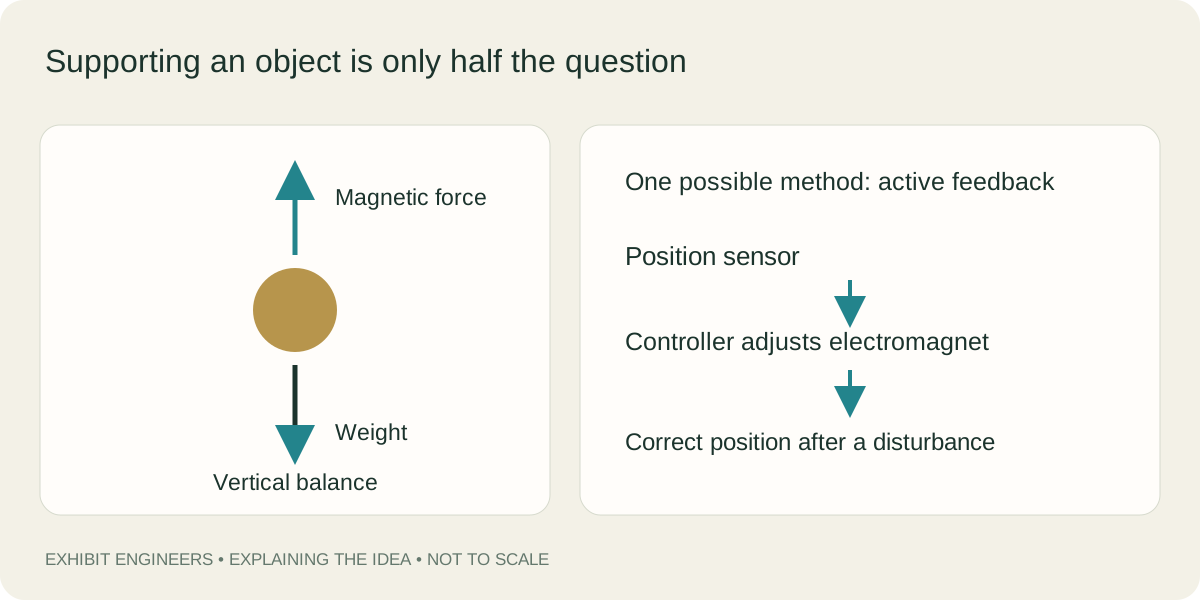
For an object held at rest, the total force must balance. If magnetic force provides all upward support, it equals the weight; gravity has not disappeared. Then ask what happens after a small displacement: does the object return toward its position, drift away or begin to oscillate?[1]
Harvard illustrates a simple instability: a magnet balanced by upward attraction can move slightly upward, experience stronger attraction and rise farther. A small downward movement can let gravity win instead. Momentary balance does not establish stable suspension. Look for a restoring response, not one frame where an object appears still.[2]
02 / EXPLAINING THE IDEA
Feedback turns a changing gap into a control signal
An active suspension measures position and adjusts an electromagnet. MIT's apparatus uses an optical distance sensor and controller to change the field as the suspended assembly moves. Sensor, control rule and coil act together: balancing weight is insufficient if the response pushes a displaced object farther from its target.[1]
Draw a loop: measure position, compare it with a target, change the field, then measure again. Ask where delay or an incorrect response could enter. This teaching model does not identify the controller or sensor inside a particular exhibit.
03 / EXPLAINING THE IDEA
Several magnetic methods can produce a floating effect
Magnetic levitation names a result rather than one universal mechanism. Diamagnetic materials develop a response that favors weaker-field regions; suitable arrangements can provide restoring forces. Harvard uses graphite to stabilize a small suspended magnet. This differs from an electronic controller continually correcting a measured gap.[2]
Changing magnetic fields can also induce currents in conductors. In MIT's jumping-ring demonstration, an alternating-current coil can sustain a conducting ring above its lower position, whereas a ring with a cut does not levitate in the same way. Compare the methods below without assuming that the bulb or disc product uses the university apparatus.[3]
| Approach | Relevant feature | What must be established |
|---|---|---|
| Active suspension | Sensor and controlled electromagnet | Control response and operating range |
| Induction-based lift | Changing field and conducting path | Field drive and conductor geometry |
| Diamagnetic stabilization | Material response and field arrangement | Material identity and restoring directions |
| Superconducting demonstration | Cooled material and magnetic interaction | Temperature, material and preparation |
04 / EXPLAINING THE IDEA
A superconducting track adds different conditions
In Oberlin College's demonstration, a cooled YBCO superconducting pellet levitates above a magnetic track. Its enhanced flux pinning can also allow suspension below an inverted track. The preparation and material matter: that result cannot be assigned to an ordinary room-temperature display merely because both appear to float.[4]
Flux pinning helps constrain the superconductor's position relative to the magnetic-field arrangement while allowing movement along a suitable track. Keep this example separate from the graphite demonstration and the sensor-controlled electromagnet. They can all prompt a discussion of stability, but they achieve it through different physical conditions. There is no need to call every floating object 'quantum locking.'[4][2][1]
05 / EXPLAINING THE IDEA
Floating does not mean free energy
Magnetic support and energy supply are separate questions. The actively controlled MIT apparatus uses an electrical drive; the jumping ring requires an applied alternating-current supply for sustained suspension. A passive diamagnetic arrangement can remain suspended without a continuous electronic correction loop. Such static support does not imply a source of unlimited usable energy.[1][3][2]
Make an energy inventory before proposing an explanation for an illuminated floating object. Ask about the support, lighting and any cooling or motion as separate functions. The visible lamp does not tell you whether its power arrives through a battery, a concealed connection or electromagnetic transfer. Establish that from the delivered technical information rather than selecting whichever explanation sounds most impressive.
06 / EXPLAINING THE IDEA
Use an exhibit to separate evidence from explanation
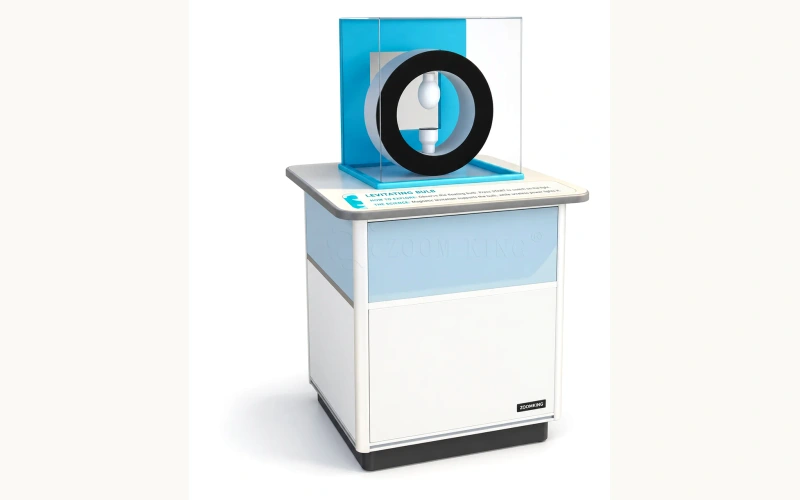
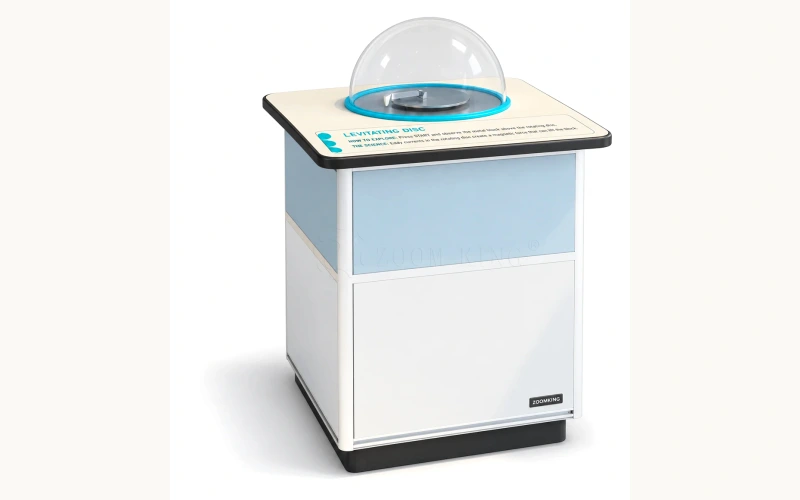
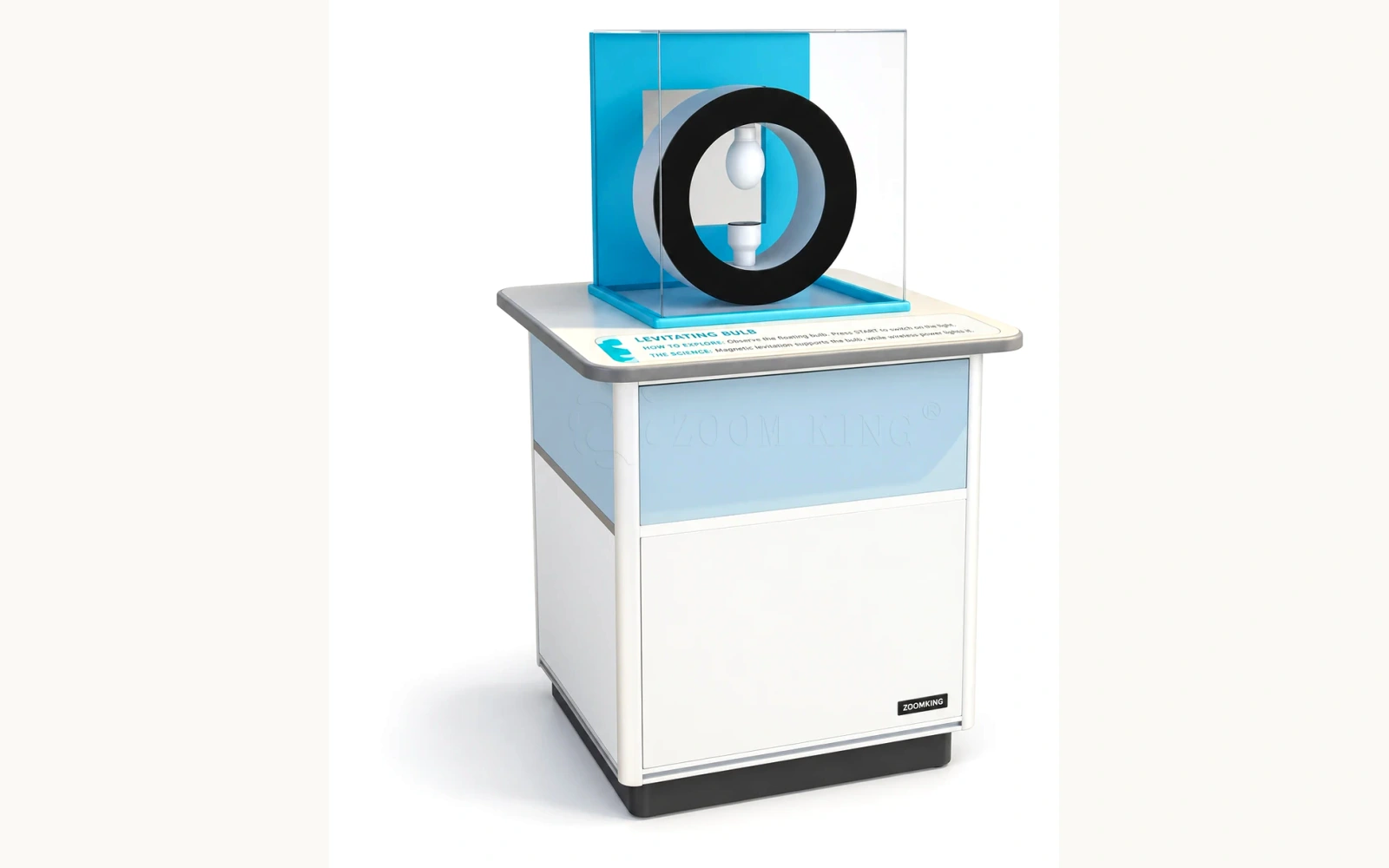
The related bulb recording shows illumination and an enclosure. Sketch those features and mark proposed hidden components with question marks. The catalogue Levitating Bulb and Eddy Current Levitation records offer product starting points, but their titles and renderings do not establish the internal system in this different physical configuration.
Give observers three questions: what is visible, what might explain it, and what evidence distinguishes alternatives? A permitted staff demonstration of recovery after a disturbance could address stability; a still photograph cannot. Confirm product limits and procedures before testing. A useful explanation states both the observed behavior and the remaining question.
Common questions.
Can two ordinary fixed magnets provide stable free suspension by themselves?
Balance at one position is insufficient. Under usual static permanent-magnet assumptions, stability in every direction is restricted; additional stabilization or different material behavior is needed.[2]
Does magnetic levitation always require electricity?
No. Some passive diamagnetic arrangements use permanent magnets, while active feedback and sustained induction demonstrations use electrical supplies. The method must be identified first.[2][1][3]
Does a floating bulb prove wireless power?
No. Suspension and illumination are separate functions. The related recording does not disclose a verified power-transfer circuit or establish the catalogue product's construction.
SCIENCE & FURTHER READING
Follow the sources.
Read the original scientific explanations and teaching resources behind this article.
- MIT 6.310: Marginal Maglev — Simplified Model
A specific sensor-controlled electromagnet illustrates force balance, feedback and stability; its dimensions and electronics are not exhibit specifications.
- Harvard Natural Sciences Lecture Demonstrations: Diamagnetic Levitation
Static-magnet instability and graphite-assisted diamagnetic stabilization under specified arrangements.
- MIT Physics Instructional Resources Lab: Jumping Ring, H22
Applied AC can sustain a conducting ring, while a slit changes its response. No coil rating or performance is transferred to a Exhibit Engineers product.
- Oberlin College: Levitation and Suspension of a Superconductor on a Magnetic Track
Cooled YBCO, enhanced flux pinning, track guidance and inverted suspension; distinct from ordinary room-temperature catalogue displays.
Editorial: Exhibit Engineers science & exhibit team. Scientific references are cited for the explanations; product configuration details follow the linked exhibit records.