THE SHORT ANSWER
The key idea, first.
A Foucault pendulum shows Earth’s rotation through slow changes in swing direction relative to the ground. The ideal precession rate depends on latitude. A short operating video illustrates swinging; measuring the predicted drift requires longer observation.
- Separate rapid swinging from slow precession relative to the floor.
- Explain why latitude changes the predicted precession rate.
- Identify the evidence needed to measure drift reliably.
WATCH & NOTICE
Look closely at the demonstration.
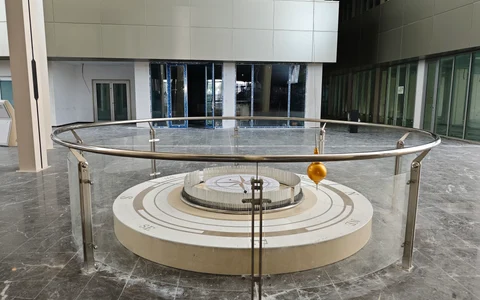
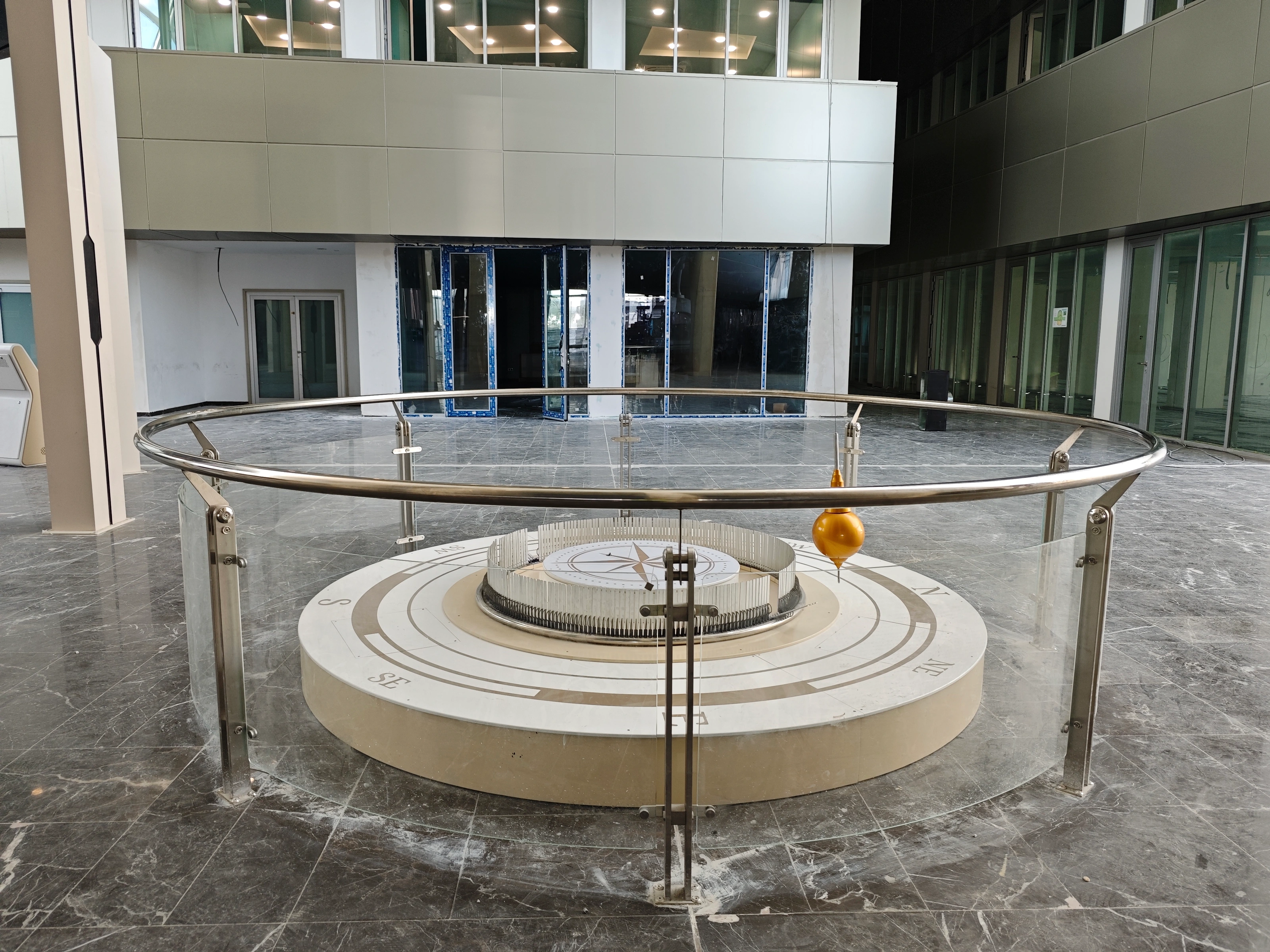
The physical installation recording shows a suspended bob above a circular, marked base. Begin with the floor reference rather than the camera’s position.
Follow one return
Watch the bob leave and return; distinguish a complete swing from one crossing.
Choose a fixed mark
Locate a compass marking on the base that can serve as a ground reference.
Notice the viewpoint
Compare views and identify changes caused by the moving camera.
About this video reference
The edited 22-second video does not establish latitude, elapsed observation time or Earth-induced precession. It is physical operating footage, not a time-lapse measurement or a full-day test.
01 / EXPLAINING THE IDEA
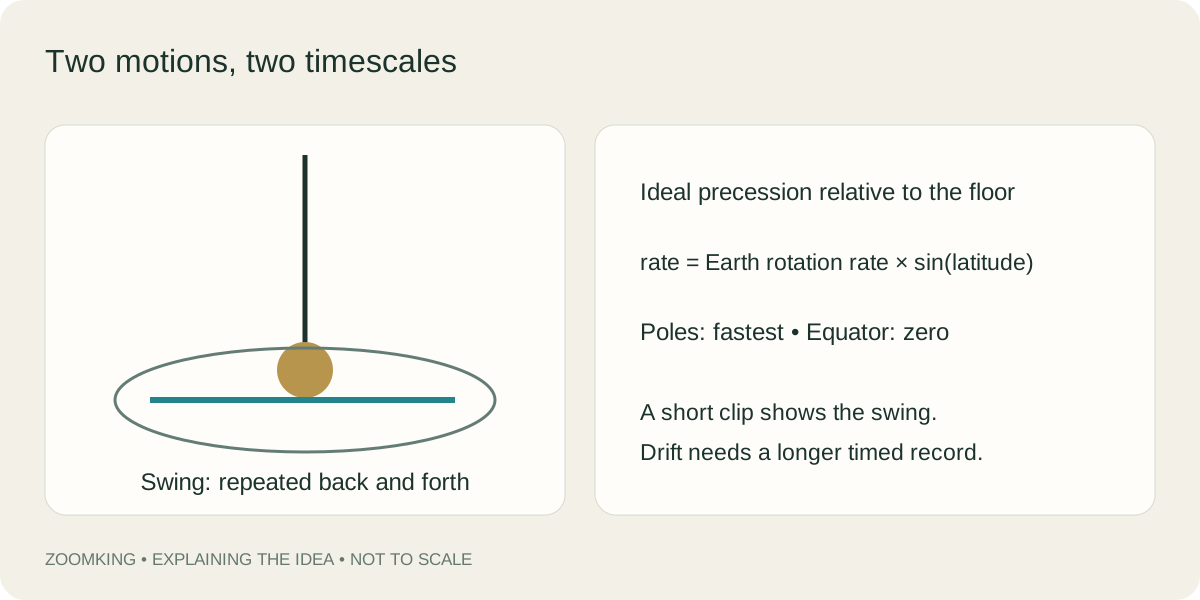
One display contains two different timescales
The bob’s repeated movement is easy to see. The scientific question concerns something slower: whether its swing direction changes relative to the building. In the local installation, compass markings on the circular base supply a visible reference. A description such as “the bob moved left” is incomplete until the observer specifies left relative to what.
Before reading an explanation, sketch one swing and mark a fixed direction on the same drawing. Then ask which observation would require returning later. This separates an immediate impression from a claim about gradual change. The bob and the floor must remain in the same account; following the bob alone loses the reference needed for the investigation.
02 / EXPLAINING THE IDEA
Why the floor reference matters
At a pole, an ideal pendulum offers a useful starting picture: its swing orientation stays approximately fixed in an inertial frame while the ground turns. An observer standing on that ground sees the swing direction rotate. This apparent rotation relative to the floor is called precession.[1]
Elsewhere the geometry is subtler. The local vertical changes direction as Earth turns, so a swing plane fixed in distant space is not a generally correct explanation. In an Earth-based description, Coriolis terms account for the observed drift. The pole picture introduces reference frames; it should not be applied unchanged at every latitude.[1]
03 / EXPLAINING THE IDEA
Latitude changes the slow rotation
The ideal precession rate is proportional to the sine of latitude. Viewed from above, the drift is clockwise in the Northern Hemisphere and counterclockwise in the Southern Hemisphere. At the equator this ideal effect is zero. At either pole a full precession takes one sidereal day, approximately 23 hours 56 minutes.[2]
Compare hypothetical sites at 30° and 90° latitude: sin 30° is one-half, so the first has half the ideal rate and twice the full precession time. These are calculated examples, not measurements of the filmed installation. A measurement needs the site's latitude and a timed record.[2]
04 / EXPLAINING THE IDEA
A real pendulum also needs careful engineering
Air resistance and suspension losses reduce a real pendulum’s swing. Some installations replace lost energy: Oberlin documents an electromagnet used for that purpose in its own apparatus. Such a drive sustains oscillation; the existence of a drive does not by itself establish how faithfully a particular display measures Earth’s rotation.[3]
Draughts, friction and imperfect construction can also affect observed direction. TU Darmstadt explicitly cautions that external influences change measured motion. For the featured installation, the photographs and short recording establish visible arrangement and operation, not the hidden drive, suspension specification or correction procedure. Those details need the actual configuration record.[4]
05 / EXPLAINING THE IDEA
What a time-lapse can establish
A time-lapse compresses a long observation into a short viewing. To support a precession measurement, keep a fixed camera, a readable ground reference and a record of real elapsed time. A change in camera angle can imitate a change in swing direction. Edited views therefore cannot be treated as successive readings from one stationary instrument.
Time-lapse playback speed is not the bob’s actual speed. Label both the recording interval and the period it represents, and retain the original timing record. A useful comparison presents two labelled orientations against the same base mark. Without those controls, an attractive accelerated sequence can illustrate an idea while leaving its numerical rate unresolved.
06 / EXPLAINING THE IDEA
Build a visit around an answerable question
Give one group the task of describing a complete swing, another the task of finding ground references, and a third the task of proposing a longer observation. Compare their records before introducing the latitude equation. Each group should say what it observed directly and what it would still need to test.
For an extended visit, ask museum staff whether scheduled readings or a calibrated record are available. Record date, elapsed time, viewing direction and the chosen reference. Discuss why repeated observations are more informative than selecting one striking image. The installation becomes a lesson in how evidence is assembled, alongside the physical explanation of Earth’s rotation.
Common questions.
Does every Foucault pendulum turn once in 24 hours?
No. The ideal full precession time depends on latitude. At a pole it is one sidereal day; at intermediate latitudes it is longer, and the ideal effect vanishes at the equator.[4]
Does a heavier bob prove the effect more clearly?
Bob mass does not set the ideal latitude-dependent precession rate. Real measurement quality also depends on the suspension, launch, disturbances and observation method.[4]
Is this the same as the novel Foucault’s Pendulum?
This guide concerns the physical science apparatus. A search result for the similarly titled novel addresses a different subject; check the page’s context before using it as a science reference.
SCIENCE & FURTHER READING
Follow the sources.
Read the original scientific explanations and teaching resources behind this article.
- UNSW School of Physics: The Foucault Pendulum
Reference frames and the limits of the familiar fixed-plane explanation.
- UNSW School of Physics: Precession of a Foucault Pendulum
Latitude relation, assumptions and sources of additional drift.
- Oberlin College Physics: Foucault Pendulum
A documented example of sustaining oscillation; not the featured installation’s specification.
- TU Darmstadt Physics: The Foucault Pendulum
Practical caution about draughts, bearing friction and departures from ideal motion.
Editorial: Exhibit Engineers science & exhibit team. Scientific references are cited for the explanations; product configuration details follow the linked exhibit records.