THE SHORT ANSWER
The key idea, first.
An orrery is a mechanical representation of the solar system, usually arranging moving planet models around a central Sun. It can introduce orbital relationships and mechanical transmission. Its visible sizes, separations and motions may use different simplifications, so a working orrery should not automatically be treated as a scale model or a Kepler-accurate simulation.
- Recognize what planetary revolution represents in an orrery.
- Distinguish physical mechanism from gravitational explanation.
- Evaluate size, distance and timing as separate model choices.
WATCH & NOTICE
Look closely at the demonstration.
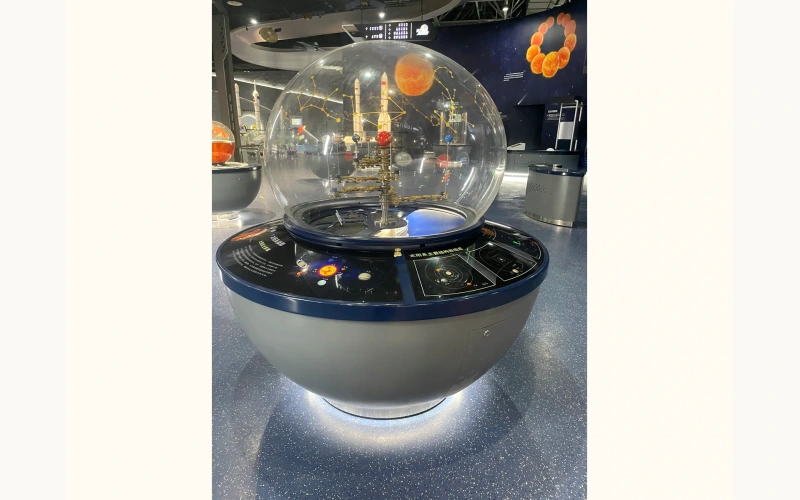
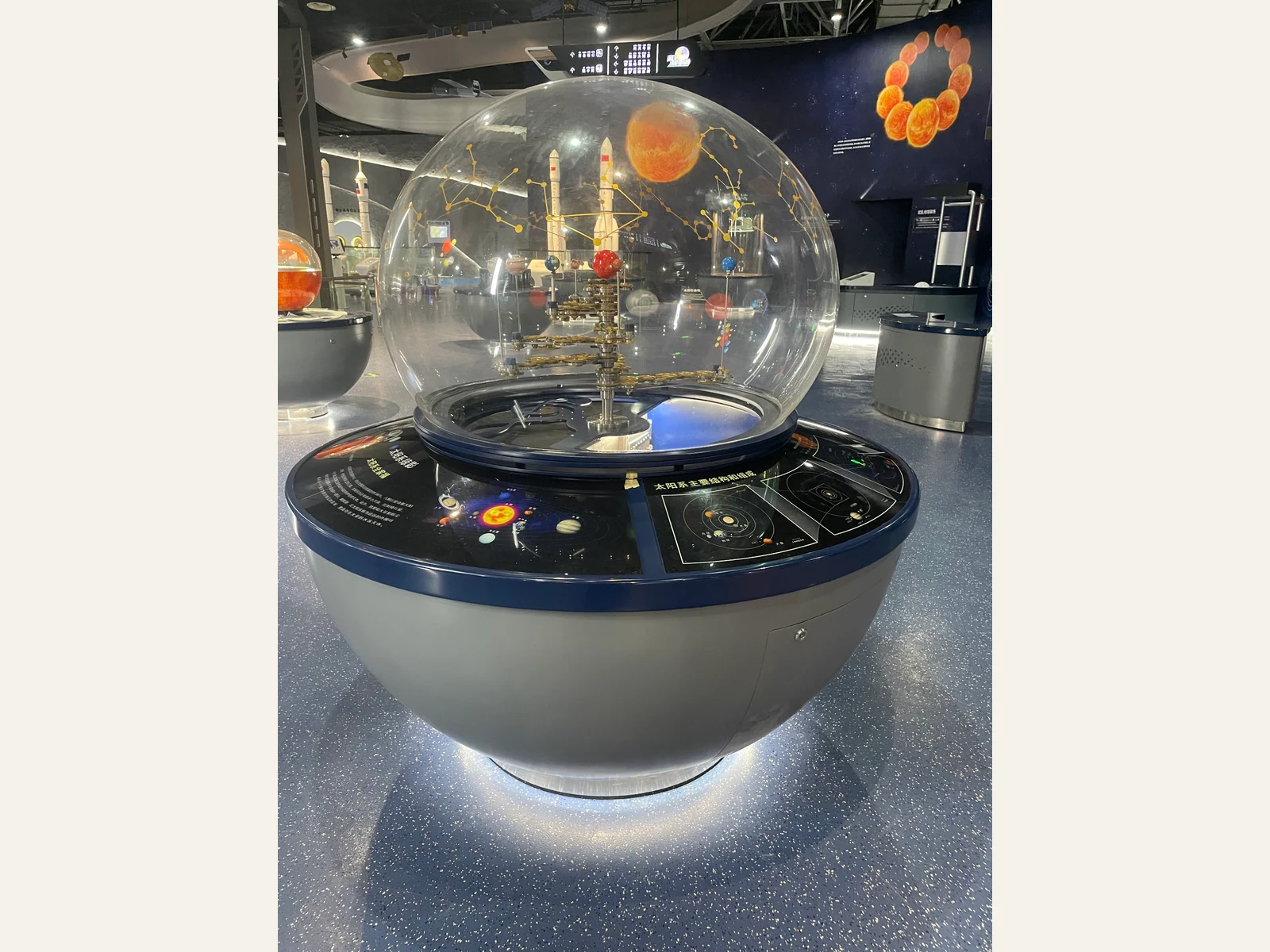
The physical operating video shows the assembly beneath its clear dome. Follow a planet model, then examine the visible gear arrangement.
Locate the center
Identify the Sun representation and the arms supporting the other models.
Choose one planet
Follow its changing position relative to the central model and base.
Compare two views
Notice visible gears while accounting for camera movement and cuts.
About this video reference
This 23-second edit confirms visible physical movement, not exact gear ratios, a complete orbital cycle, scale accuracy or Kepler-law performance. The gallery photograph illustrates the apparatus; it does not establish dimensional or timing accuracy.
01 / EXPLAINING THE IDEA
An orrery is a model of relationships
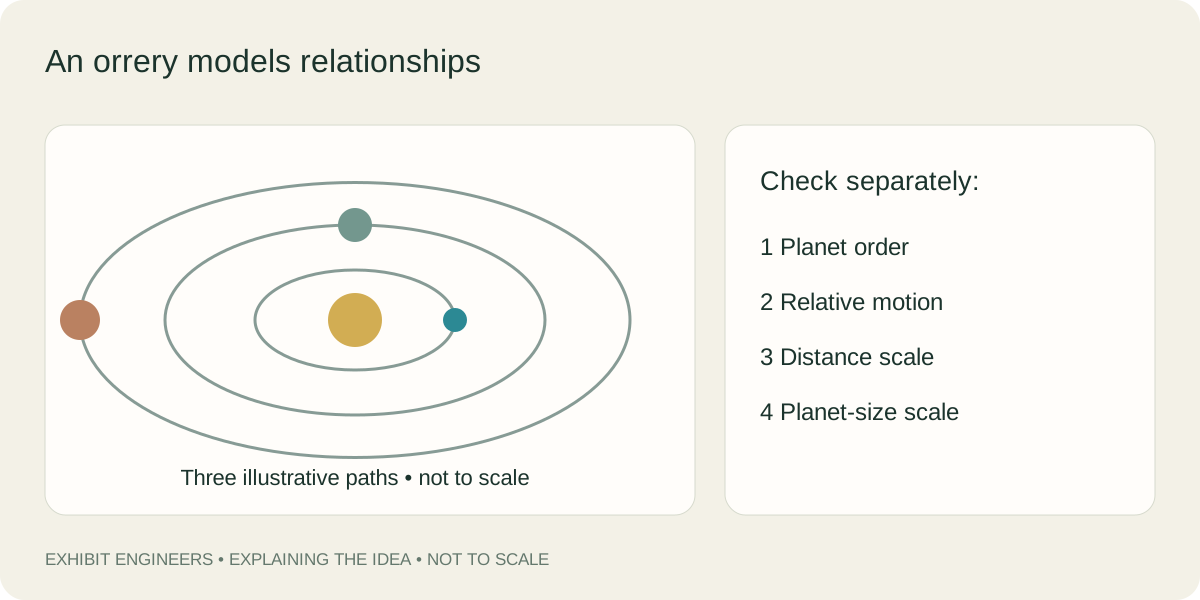
An orrery represents the solar system mechanically. Oxford’s History of Science Museum describes its example as a Sun-centered model with geared motion. The useful starting relationship is revolution: one model changes position around another. Rotation means turning about an object’s own axis, a different motion that should be identified separately.[1]
Begin a discussion by asking learners to point to the represented bodies and describe a relationship without naming a mechanism. “This model moves around the center” is an observation. “It reproduces a planet’s year accurately” is a further claim requiring timing evidence. Keeping these statements separate gives the moving display a clear scientific role.
02 / EXPLAINING THE IDEA
Follow the mechanism, then ask about the cause
The local source photographs show radial arms, colored celestial models and exposed gears around a central shaft. The operating footage shows the assembly in different positions beneath a transparent dome. These details offer a direct engineering question: which visible components move together, and where does the motion pass between components?
Planets in space have no gears or arms. NASA’s space-flight guide explains curved trajectories through gravity and continuing motion. The supports belong to the model, rather than the represented cause. Ask learners to draw separate diagrams for the mechanism and the astronomical relationship.[3]
03 / EXPLAINING THE IDEA
Size scale and distance scale are separate questions
A model can preserve a distance ratio while enlarging the planets enough to see. It can also compare planet diameters while compressing their separations. NASA JPL’s model-building guide treats size and distance separately because displaying both faithfully within a compact scene is difficult. A familiar-looking lineup does not reveal which choice was made.[2]
Test the claim before using a ruler: does the interpretation specify one common scale for diameters and separations? If not, use the apparatus to discuss arrangement rather than infer distances. Ask learners to propose a second display that would answer the missing question. A compact moving model and a spread-out distance activity can serve different purposes.
| Model question | Evidence to seek | What appearance alone cannot establish |
|---|---|---|
| How large are the planets? | Stated diameter scale | A shared distance scale |
| How far apart are their orbits? | Distance scale and labeled reference | Accurate planet diameters |
| How long is an orbit? | Timed full cycles and calibration | A real planetary year |
04 / EXPLAINING THE IDEA
A moving mechanism does not automatically reproduce orbital laws
In the ideal planetary model, paths are ellipses with the Sun at a focus; equal intervals correspond to equal swept areas. Larger semimajor axes imply longer periods. A display may simplify any of these relationships.[5]
To assess timing, select a fixed reference and count complete returns of two models over the same measured interval. Then compare their period ratio with documented intended values. Camera motion and a short clip cannot supply that calibration. Avoid concluding that a mechanism obeys Kepler’s laws merely because the inner and outer models appear to move differently.
05 / EXPLAINING THE IDEA
Use a distance walk to reveal what a tabletop view compresses
A contrasting example is the National Astronomical Observatory of Japan’s Solar System Walk. Its stated scale is one to fourteen billion, and its Sun-to-Saturn separation is about 100 meters. This is a documented choice that visitors experience by walking; it is not a dimension or recommended layout for the featured mechanical exhibit.[4]
Invite learners to compare what each format makes easy to notice. The orrery puts moving relationships within one view. A distance route asks observers to travel between marked positions. Have each group write a caption explaining the question its chosen format answers, then a second sentence naming the question it leaves open.
06 / EXPLAINING THE IDEA
Turn looking into a model-reading exercise
Choose one visible model, one motion and one uncertainty. Record its position relative to the center, identify any part of the path hidden by the housing, and note whether the camera changes viewpoint. This gives the class a manageable observation task without assuming every visible detail has a literal astronomical counterpart.
Finish with a proposed interpretation label: name the represented relationship, state any verified simplification and explain what remains unmeasured. For this physical orrery, the local records support visible gears, arms and moving celestial models. Exact transmission, timing calibration and scale fidelity require configuration evidence. Those boundaries can become productive questions for the next investigation.
Common questions.
Is an orrery always to scale?
No. A model may simplify diameters, distances or both. Check its stated scales independently; a recognizable solar system arrangement does not establish accurate proportions.[2]
Do orrery gears explain why planets orbit?
They explain how the model moves. Real planets follow gravitationally governed trajectories; the arms and gears represent relationships without reproducing gravity as the driving mechanism.[3]
Does an orrery predict planet positions?
Only if its intended function, reference date and timing calibration support that use. The featured short operating recording does not establish an astronomical prediction capability.
SCIENCE & FURTHER READING
Follow the sources.
Read the original scientific explanations and teaching resources behind this article.
- Oxford History of Science Museum: Orrery
Mechanical representation and the distinction between visible models and astronomical scale.
- NASA JPL Education: Make a Scale Solar System
Separate size and distance scales, with methods for constructing explicit scale models.
- NASA Basics of Space Flight: Gravity & Mechanics
Gravitational acceleration and the orbital relationships a model may simplify.
- National Astronomical Observatory of Japan: The Solar System Walk
A separately documented distance-scale installation for comparison.
- Bavarian Academy of Sciences: The Planetary Laws
Independent statement of orbit shape, swept area and period relationships.
Editorial: Exhibit Engineers science & exhibit team. Scientific references are cited for the explanations; product configuration details follow the linked exhibit records.