THE SHORT ANSWER
The key idea, first.
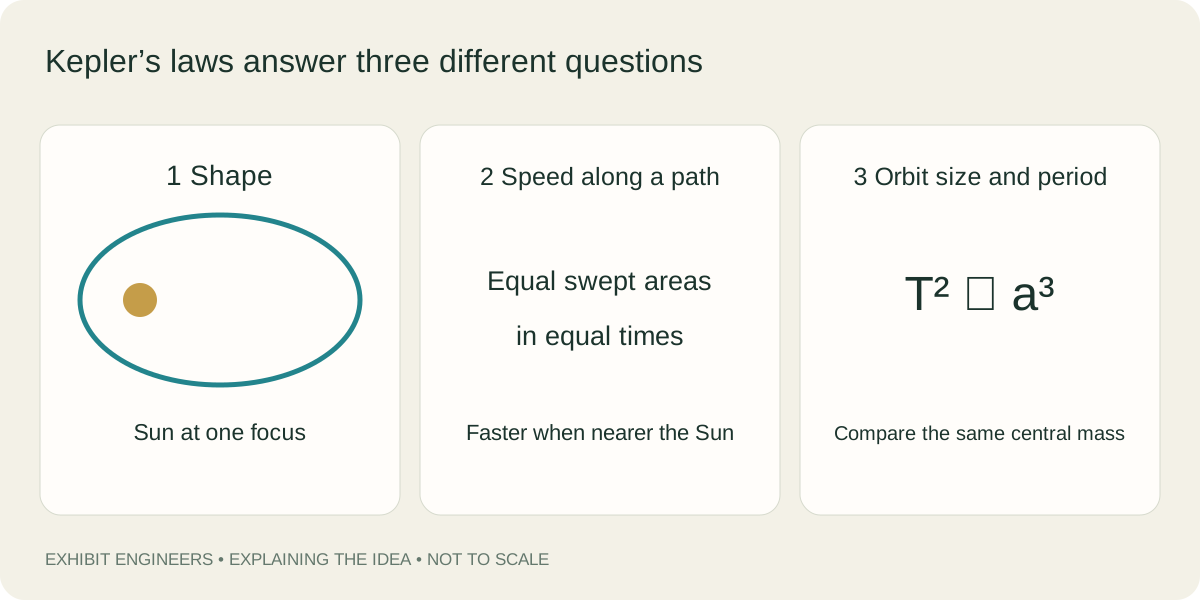
Kepler’s laws describe the geometry and timing of ideal planetary orbits. First, an orbit is an ellipse with the Sun at one focus. Second, the Sun-to-planet line sweeps equal areas during equal times. Third, orbital period squared is proportional to semimajor axis cubed for bodies orbiting the same dominant mass.
- Locate a focus and distinguish it from an ellipse’s center.
- Relate equal swept areas to changing orbital speed.
- Use a period ratio while stating the model’s assumptions.
WATCH & NOTICE
Look closely at the demonstration.
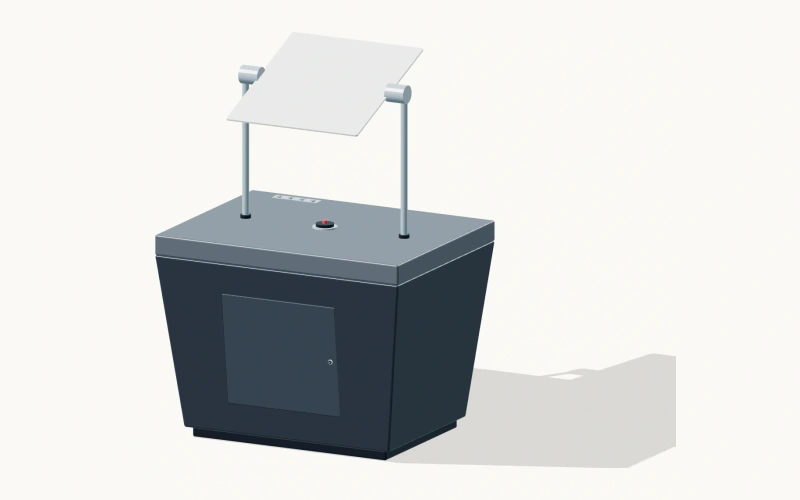
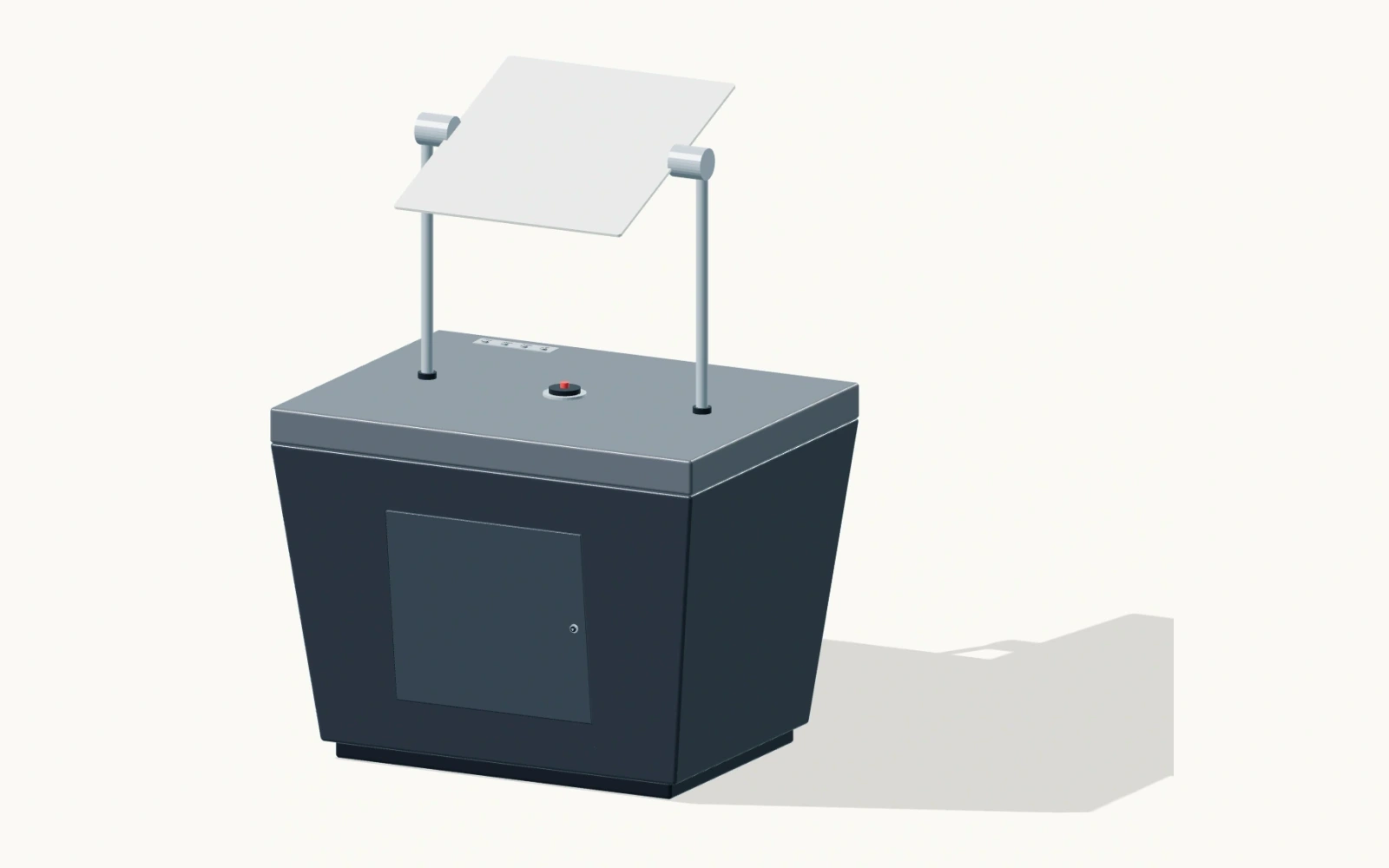
The featured First Law video is a 3D concept demonstration of a cone and an adjustable plane, associated with orbit geometry.
Find the plane
Locate the plane intersecting the cone and follow its orientation.
Compare outlines
Ask which displayed section resembles an ellipse and where a focus would need marking.
Separate geometry from motion
Identify what additional timing information would be needed to describe an orbit.
About this video reference
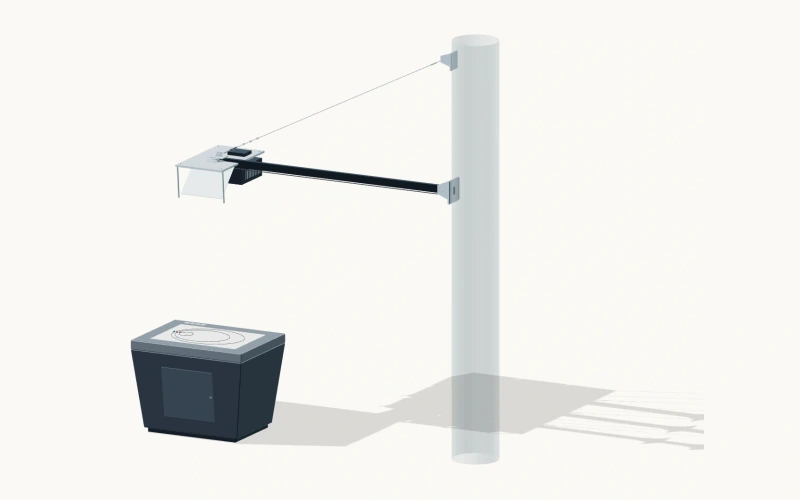
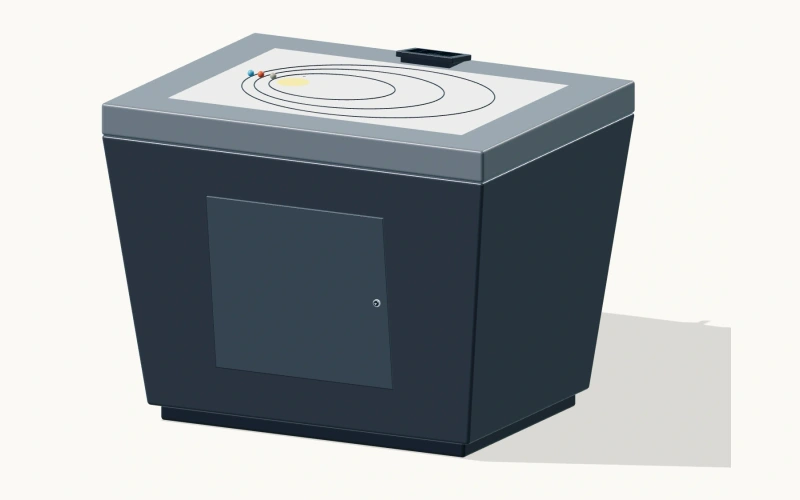
This is an illustrated 3D concept sequence, not physical operating proof. The linked Second and Third Law videos are 3D design previews with camera movement, not measured orbital demonstrations or performance tests.
01 / EXPLAINING THE IDEA
Three questions clarify the three laws
Ask first where an orbit goes, then how a body progresses along it, then how different orbital sizes compare. These questions keep geometry, changing speed and period distinct. A drawing of an oval may help with the first question while leaving the other two completely unanswered.
The Bavarian Academy of Sciences’ Kepler project identifies the first two laws with Astronomia Nova in 1609 and the third with Harmonice Mundi in 1619. This historical sequence is useful context rather than a substitute for testing the statements. Ask learners what marks or measurements each law would require on a diagram.[1]
02 / EXPLAINING THE IDEA
First law: place the Sun at a focus
An ellipse has two foci. For any point on its boundary, the sum of the distances to those foci is constant. The Sun occupies one focus in the ideal planetary description, not generally the geometric center. A circle is the special case in which the two foci coincide.[6]
An optical conic-section display can introduce the shape, but the outline alone does not identify the Sun’s position. Add a center mark and two focus marks to a separate teaching sketch, then ask which mark represents the Sun. This prevents a tilted-plane demonstration from being mistaken for a complete account of orbital motion.
03 / EXPLAINING THE IDEA
Second law: compare areas over the same time
Imagine drawing the line from the Sun to a planet throughout a fixed interval. The region it sweeps has the same area as the region swept during any other equal interval on that orbit. The areas can have different shapes. Equal swept area does not mean equal distance traveled along the path.[3]
NASA Goddard’s explanation uses differently shaped regions to illustrate this distinction. Near the central body, an equal-area region corresponds to a longer stretch of path, so the object moves faster. For a classroom sketch, shade two equal-area regions and label the time interval on both before discussing their different arc lengths.[3]
04 / EXPLAINING THE IDEA
Third law: compare one complete orbit with another
Period is the time for a complete orbit. Semimajor axis is half the ellipse’s longest diameter; it is not the changing instantaneous distance from the Sun. For negligible-mass bodies orbiting the same dominant mass, the square of the period ratio equals the cube of the semimajor-axis ratio.[2]
Consider two hypothetical orbits with semimajor axes in the ratio 4:1. Their periods have the ratio √(4³):1, or 8:1. Doubling orbital size would instead multiply period by √8, about 2.83. These calculations illustrate a relationship, not measured cycle times or drive settings for the linked exhibit designs.[2]
05 / EXPLAINING THE IDEA
Describing a path and explaining its cause are different steps
Kepler’s laws summarize orbital relationships. Newton’s gravitational theory supplies their dynamical explanation. NASA describes this connection while noting the importance of generalized mass-dependent relations. Gravity is not a gear train pulling a planet around a rigid track; it continuously changes the body’s motion.[4]
Real orbital calculations can require more than an isolated ellipse. NASA’s space-flight guide explicitly qualifies the geometric orbit description when other objects perturb it. Begin with the simpler model because its assumptions are clear, then ask what new influence a more detailed calculation must include. A useful model has a stated domain, not an obligation to represent every effect.[5]
06 / EXPLAINING THE IDEA
Use the three exhibit references as three discussion stations
At a First Law station, discuss the ellipse and the missing focus labels. At a Second Law station, ask what would establish equal intervals and swept areas. At a Third Law station, ask how a complete cycle and an orbital-size ratio would be measured. These are proposed activities; the previews do not certify that the apparatus performs those measurements.
The archived First Law sequence is a concept demonstration. The Second and Third Law records are camera views around 3D designs. Use them to discuss geometry and interpretation, while checking actual controls, mechanisms and operating specification separately. Finish by having each group write one observation its reference supports and one claim that still needs evidence.
Common questions.
Does the second law mean constant orbital speed?
No. Equal areas in equal times generally require changing speed along an elliptical orbit. The area is measured from the focus occupied by the Sun, not from the ellipse’s center.[3][4]
Can I use T² = a³ with any units?
The familiar solar approximation uses T in years and a in astronomical units for a small body orbiting the Sun. For the ratio form, use matching time and length units for both orbits.[6]
Do the 3D exhibit videos verify Kepler’s laws?
They provide concept and design references. They do not establish measured equal areas, correct period ratios or the performance of a built physical installation.
SCIENCE & FURTHER READING
Follow the sources.
Read the original scientific explanations and teaching resources behind this article.
- Bavarian Academy of Sciences: The Planetary Laws
Scholarly statement of the laws and their publication context.
- OpenStax University Physics: Kepler’s Laws of Planetary Motion
Ellipse geometry, semimajor axis and the period relationship.
- NASA Goddard Imagine the Universe: Kepler’s Second Law Description
Different swept-region shapes, equal times and changing orbital speed.
- NASA Science: Orbits and Kepler’s Laws
Concise law statements, astronomical-unit convention and Newtonian context.
- NASA Basics of Space Flight: Gravity & Mechanics
Perturbations and the limits of an isolated orbital description.
- OpenStax Astronomy 2e: The Laws of Planetary Motion
Ellipse geometry, the circular limiting case and astronomical units.
Editorial: Exhibit Engineers science & exhibit team. Scientific references are cited for the explanations; product configuration details follow the linked exhibit records.