
THE SHORT ANSWER
The key idea, first.
A spinning mechanical gyroscope carries angular momentum. With negligible net external torque, that angular momentum keeps its direction. A torque changes it; a torque perpendicular to the angular momentum can turn its direction and produce precession. Gravity still acts. The support arrangement and the applied torque determine the response, so a spinning wheel does not automatically remain upright in every situation.
- Distinguish wheel spin from movement of the spin axis.
- Explain how an external torque changes angular momentum.
- State the conditions behind the slow-precession approximation.
WATCH & NOTICE
Look closely at the demonstration.
Watch this related supported-wheel demonstration: an operator starts the wheel by hand. Observe wheel spin and axle orientation separately.
Identify the support
Locate the suspended supports and handled wheel. Include the support geometry in its explanation.
Separate the two motions
Follow the wheel's continued turning after the hand moves away, then compare the orientation of its axle.
Limit the conclusion
Describe wheel orientation without assigning a measured spin speed, precession rate or torque.
About this video reference
Related physical demonstration · Different configuration. Its cabinet and components differ from the catalogue rendering. This qualitative reference does not establish numerical performance of the catalogue product.
01 / EXPLAINING THE IDEA
Start with a wheel and an arrow
Angular momentum describes rotational motion with both a size and a direction. For a symmetric wheel spinning about its symmetry axis, its spin angular momentum has magnitude Iω: moment of inertia multiplied by angular speed. Moment of inertia accounts for how mass is distributed relative to that axis.
Use the right-hand rule to give the arrow a direction: curl your fingers with the rotation and your thumb points along the angular momentum. Reversing the spin reverses this arrow. The arrow is a drawing convention for a physical quantity, not another force pushing out of the axle.[1]
02 / EXPLAINING THE IDEA
An axis changes when a torque changes the arrow
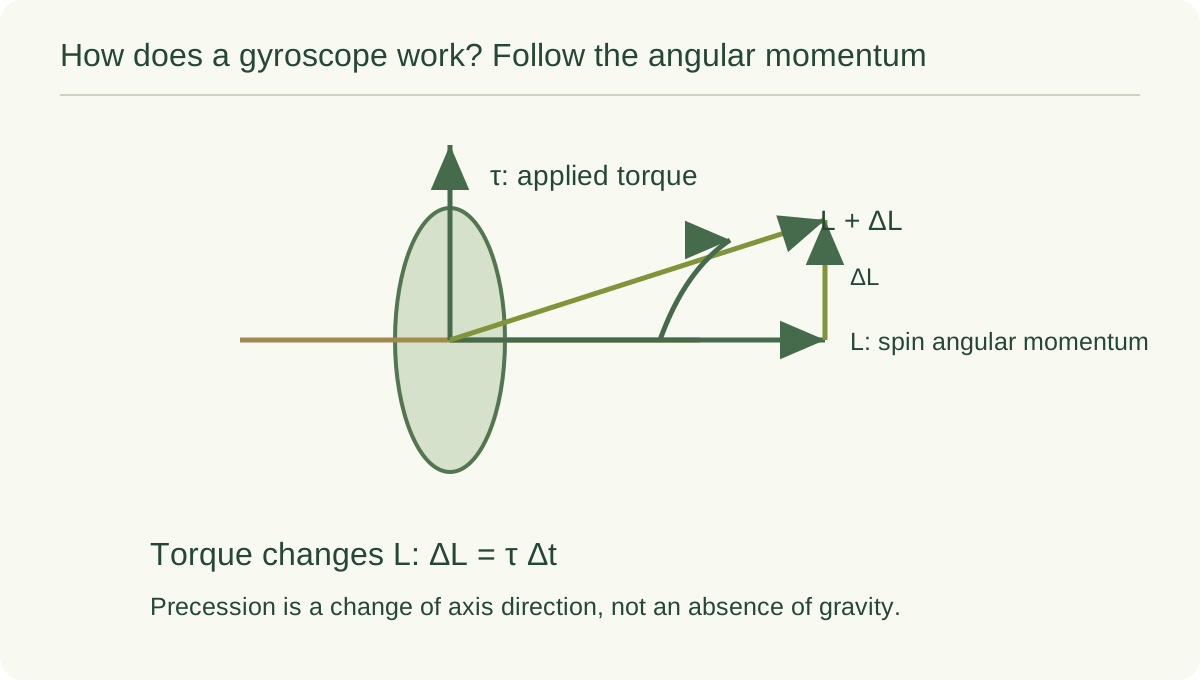
The governing relationship is that net external torque equals the rate of change of angular momentum, with both measured about the same point. A torque parallel to the angular momentum can change its magnitude. A perpendicular torque changes its direction at that instant.
Picture adding a small sideways arrow to a long forward arrow. The result points slightly sideways with nearly the same length. This helps explain a spinning wheel's surprising response. Support constraints still determine which movements are possible.[1]
03 / EXPLAINING THE IDEA
Gravity produces precession rather than disappearing
Consider a fast-spinning, tilted symmetric top with a fixed pivot below its centre of mass. Gravity acts downward and produces a torque about that pivot. Under suitable conditions the spin axis sweeps around the vertical: precession. The torque changes the direction of angular momentum rather than simply adding a downward tilt.
The support also exerts forces. Without it, the top would fall. A wheel supported through its centre of mass is a different problem because gravity then produces no torque about that centre. Always identify the pivot, centre of mass and available axes before applying a familiar gyroscope explanation.[2]
04 / EXPLAINING THE IDEA
An ideal example of slow precession
For an invented symmetric rotor, take mass m = 0.50 kilogram, pivot-to-centre distance r = 0.040 metre, spin moment of inertia I = 0.0020 kilogram metre squared and spin speed ω = 100 radians per second. With g = 9.8 metres per second squared, the approximation gives Ω = 0.98 radian per second: about 6.4 seconds for one precession circuit.
Precession is much slower than spin here. Doubling spin speed with everything else fixed gives approximately 0.49 radian per second. These hypothetical values are not measurements or specifications for the filmed wheel.[2]
05 / EXPLAINING THE IDEA
Why real wheels slow and ideal models have limits
Conservation of angular momentum applies when net external torque is zero. It does not mean every individual spinning part keeps its motion unchanged while interacting with its surroundings. Bearing friction can exert a torque on a wheel and reduce its spin. A demonstration is therefore an approximation over a useful interval, not perpetual motion.
As spin declines, a description that neglects the angular momentum of other motions can become less reliable. For a classroom comparison, note whether spin, axis movement and support movement are being confused. Record those separately before deciding that a change in behaviour contradicts conservation.[3]
06 / EXPLAINING THE IDEA
Read the related demonstration carefully
The local clip shows manual starting and continued wheel rotation after the hand moves away. Later views allow comparison of wheel orientation. Draw the axle and discuss where external torques might enter.
Mass distribution, support forces and spin rate are unmeasured here. The cabinet and components differ from the catalogue design. Keep that distinction explicit.
- Name the object and the support being observed.
- Draw spin and axis movement with different arrows.
- List the quantities a numerical test would still require.
07 / EXPLAINING THE IDEA
Connect the wheel to a real sensing task
NASA describes Hubble's mechanical gyroscopes as sensors that help determine how the telescope is turning. Their measurements enter a pointing system; reaction wheels then provide control action. This separates sensing rotation from actively changing the spacecraft's orientation.
Discuss what learners could measure and how a controller might use it. A science-centre wheel illustrates a principle without representing every spacecraft component.[4]
Common questions.
Does a gyroscope cancel gravity?
No. Gravity and support forces still act. When gravity produces torque about a suitable pivot, a fast-spinning top can precess; the motion is a response to that torque.
Does faster spin always mean faster precession?
No. In the stated slow-precession model, increasing spin while holding mass, pivot distance and moment of inertia fixed reduces precession speed. Other arrangements require their own analysis.
Does the video show the catalogue configuration?
It shows a related physical demonstration with a different cabinet and component arrangement. Its visible actions support qualitative discussion, not product-specific speed, torque or stability claims.
SCIENCE & FURTHER READING
Follow the sources.
Read the original scientific explanations and teaching resources behind this article.
- OpenStax — University Physics Volume 1, 11.2 Angular Momentum
Angular momentum as a vector and the relationship between net external torque and its time derivative.
- OpenStax — University Physics Volume 1, 11.4 Precession of a Gyroscope
Gravity-driven precession and the requirement that precession be much slower than spin; the article's numerical values are independently chosen.
- OpenStax — University Physics Volume 1, 11.3 Conservation of Angular Momentum
Zero-net-external-torque condition, system boundaries and frictional slowing of a wheel.
- NASA Science — Operating Hubble with Only One Gyroscope
Used only for the distinction between mechanical gyro sensing and reaction-wheel control, not for an assertion about Hubble's present operational state.
Editorial: Exhibit Engineers science & exhibit team. Scientific references are cited for the explanations; product configuration details follow the linked exhibit records.