THE SHORT ANSWER
The key idea, first.
Examples of the six simple machines include a seesaw (lever), a flagpole pulley, a doorknob (wheel and axle), a ramp (inclined plane), a doorstop (wedge) and a threaded jar lid (screw). These devices change force, direction or movement. A machine that reduces the required input force generally requires a longer input movement; it does not create energy.
- Recognize six machine types through their working parts.
- Distinguish force advantage from energy gain.
- Identify a lever's pivot and perpendicular force arms.
WATCH & NOTICE
Look closely at the demonstration.
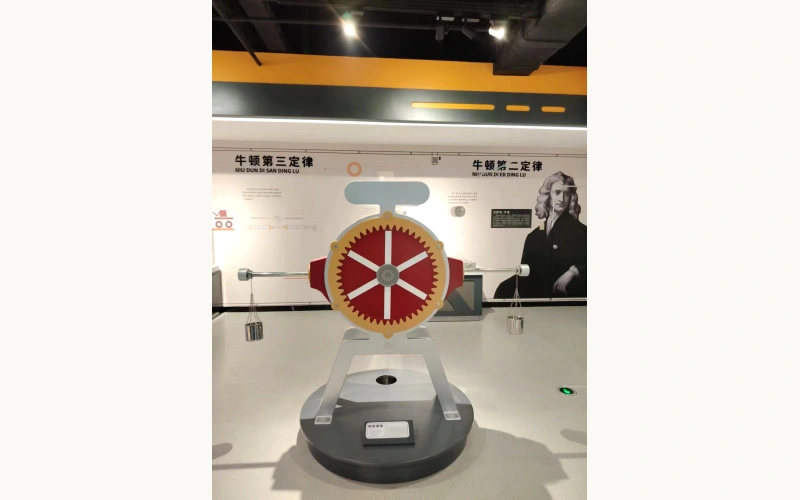
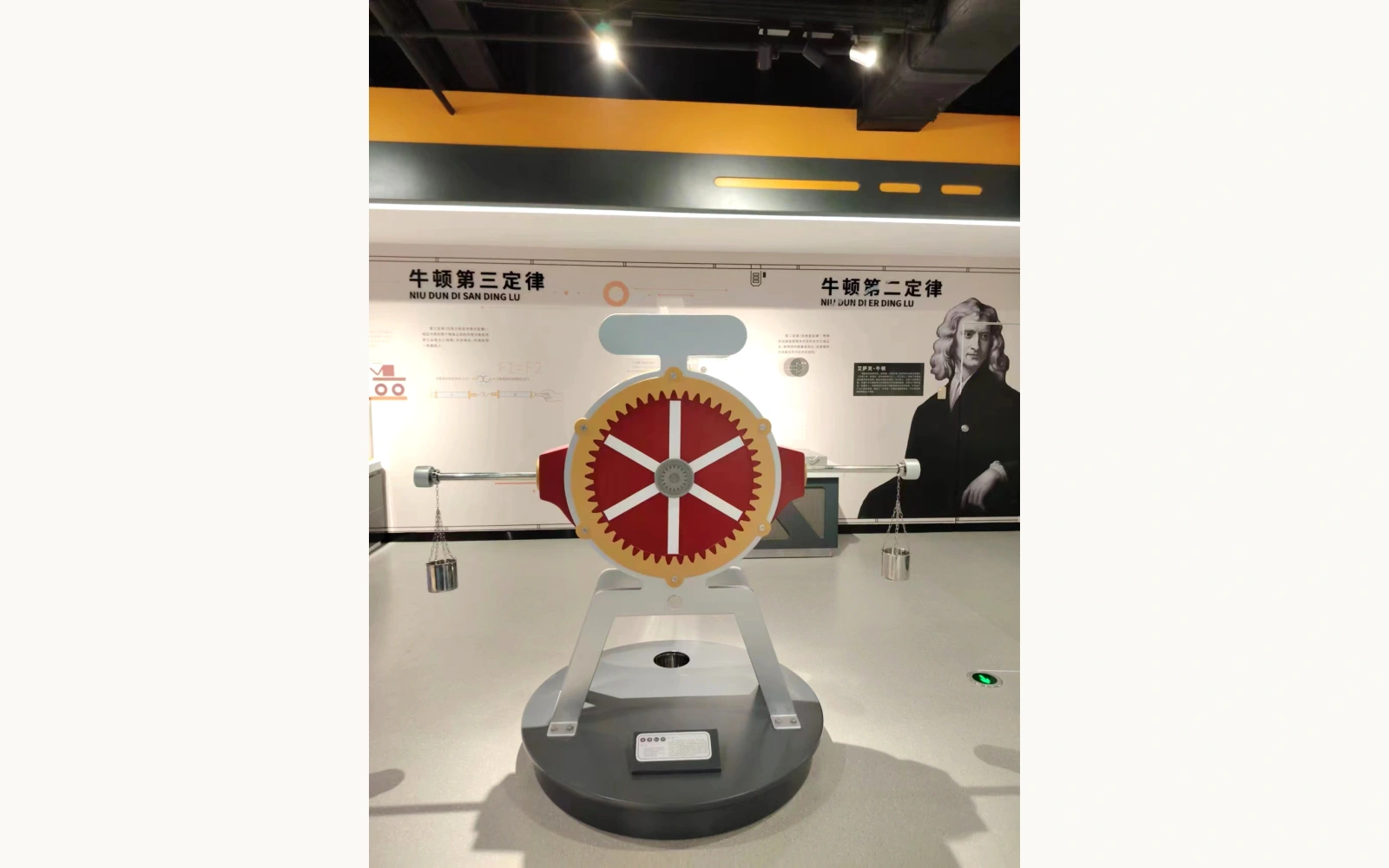
The Unusual lever recording shows a physical exhibit with a circular housing, visible internal bars and hanging elements. Use it to investigate one mechanism rather than searching for all six machine types.
Locate the interaction
Watch where the visitor reaches toward a hanging element beside the circular housing.
Track one part
Compare the orientation of a visible internal bar across the recording.
Separate shape from geometry
Sketch a possible pivot and force direction; mark anything the viewing angle leaves uncertain.
About this video reference
This physical reference footage provides no calibrated forces, perpendicular arm measurements or verified mechanical advantage. It does not demonstrate every simple machine.
01 / EXPLAINING THE IDEA
Start with what an object helps you do
Before naming a machine, describe its task. Are you raising, turning or fastening something? Identify where a hand applies a push or pull, then watch what moves elsewhere. This connects a familiar object to an input and an outcome.
Draw two arrows: one for the input and another for the resulting motion. Add a question where a part is hidden. A useful answer can include uncertainty: saying that the pivot is obscured is more informative than confidently labeling an unseen point.
02 / EXPLAINING THE IDEA
Recognize six types in everyday examples
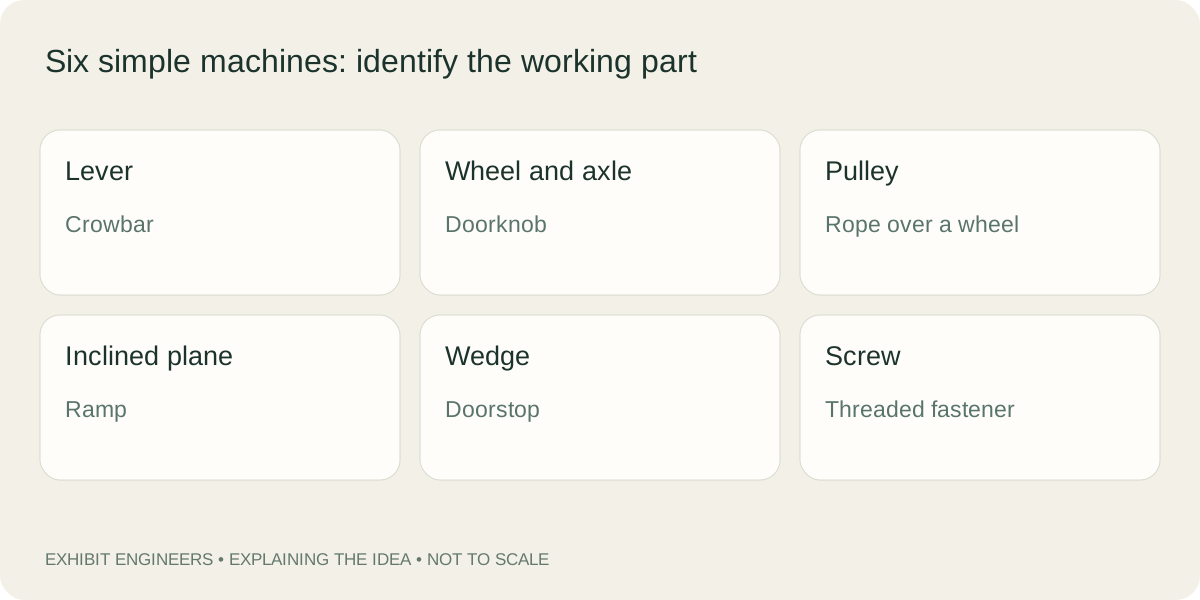
The conventional six types are lever, pulley, wheel and axle, inclined plane, wedge and screw. Their working geometry matters more than their appearance. A screw's thread follows a spiral path; a wedge advances between surfaces; a lever turns about a pivot. A whole tool can contain several types, so classify a working part rather than assuming every object fits only one box.[1]
Ask learners to draw another example and mark the feature supporting their choice. A circular decoration alone does not establish a wheel-and-axle mechanism: its connection and movement must do a job.
| Type | Everyday example | Working feature |
|---|---|---|
| Lever | Seesaw | A beam turns around a fulcrum. |
| Pulley | Flagpole pulley | A rope passes over a grooved wheel. |
| Wheel and axle | Doorknob | A larger turning part drives a smaller shaft. |
| Inclined plane | Ramp | A slope provides a path to a different height. |
| Wedge | Doorstop | A tapered shape fits between surfaces. |
| Screw | Threaded jar lid | A spiral thread converts turning into axial movement. |
03 / EXPLAINING THE IDEA
A lever depends on force direction as well as length
A lever's turning effect is torque. It depends on force and the perpendicular distance from the pivot to the force's line of action. This force arm need not equal the distance along a bent handle. Moving a hand or changing the push direction can change the turning effect.[2]
Imagine a light horizontal bar with one downward load on each side. Equal loads balance at equal distances; a smaller load can balance a larger one farther from the pivot. Draw the arrows and compare perpendicular distances. Include the bar's weight if it contributes significant torque.[2]
04 / EXPLAINING THE IDEA
Mechanical advantage trades force against movement
Mechanical advantage is the output-force magnitude divided by the input-force magnitude. A value greater than one means the output force is larger. In an ideal machine, that benefit is accompanied by a smaller output movement. The input end travels farther. The machine changes the combination of force and distance rather than supplying extra energy.[3]
For a steady, frictionless lift, input energy equals the load's gain in gravitational potential energy. Real machines also transfer energy into heating and other losses. A lower hand force therefore does not mean less energy input. Compare both force and distance before deciding what the machine makes easier.[3]
05 / EXPLAINING THE IDEA
Compare a ramp, a pulley and a compound tool
A longer, gentler ramp can reduce the force needed for a slow lift to the same height, at the cost of a longer route. Friction can change the practical result. A single fixed pulley mainly changes the direction of the pull; it does not automatically halve the force. Pulley arrangements with multiple supporting rope sections can provide a force advantage.[4][3]
Scissors offer a useful compound example: the handles and pivot act as levers, while the blade edges act as wedges. Ask which part is being discussed when someone calls scissors a lever. One object can answer several classification questions, depending on the working part and the task.[1]
06 / EXPLAINING THE IDEA
Turn the lever exhibit into an evidence question
In the Unusual lever recording, compare the visible bars and hanging elements in early and later views. Describe changes without assigning a numerical advantage. The circular outer shape invites questions; it does not determine where every force acts.
For a classroom extension, use a separate lightweight balance with known masses and marked positions. Predict a balancing arrangement, test it and record the result alongside the prediction. Keep the installed exhibit to its designated interaction. Finish by listing the measurements needed to test the same explanation there: force direction, pivot position and perpendicular arms.
Common questions.
What are the six simple machines?
The conventional list is lever, pulley, wheel and axle, inclined plane, wedge and screw. Everyday tools can combine several of these working parts.[1]
Do all simple machines multiply force?
No. Some primarily redirect a force, and some exchange force advantage for greater output movement. Mechanical advantage depends on the arrangement.[3]
Does a curved lever break the usual rules?
No. Its torque still depends on force and perpendicular distance from the pivot to the force's line of action, rather than the curved outline alone.[2]
SCIENCE & FURTHER READING
Follow the sources.
Read the original scientific explanations and teaching resources behind this article.
- NASA: Simple Machines — Classroom Connection
The conventional six types and compound-machine classification; examples are interpreted through working parts.
- OpenStax College Physics 2e: The Second Condition for Equilibrium
Torque, perpendicular force arms and balanced opposing torques. No textbook wording, figures or numerical example reproduced.
- OpenStax College Physics 2e: Simple Machines
Mechanical advantage, conservation of energy and pulley arrangements; explanations are original paraphrases.
- University of Colorado Boulder / TeachEngineering: Engineering — Simple Machines
Ramp and pulley comparisons and familiar compound-machine examples; ideal-model conditions are stated separately.
Editorial: Exhibit Engineers science & exhibit team. Scientific references are cited for the explanations; product configuration details follow the linked exhibit records.